
The week before last I attended the Ecobuild conference at the ExCel centre in London. One of the most engaging lectures was Richard Heinberg's on 'the end of growth’ and the importance of sustainable energy alternatives to underpin a new economic system.
The community-based website Sustainable Guernsey has now transcribed this lecture and Mike, our UK Awards Manager just emailed a link to a presentation Heinberg gave along very similar lines at Totnes.
Showing posts with label energy. Show all posts
Showing posts with label energy. Show all posts
Monday, 14 March 2011
Heinberg on ‘the end of growth’


Tuesday, 15 February 2011
Oscar-nominated movie "Gasland" lifts lid on gas industry's darker side

When we talk about polluting fossil fuels, coal and oil are cited as the villains. Coal wins the prize for producing the most CO2 when burnt, as well as heavy particulates which cause ‘black soot’ in the polar regions and respiratory disease. Oil, meanwhile, gets a bad press not only because of its carbon intensity, but more recently for the Gulf of Mexico accident, and for the extraordinarily environmentally destructive project to extract bitumen from soils of Northern Canada.
Gas is often thought of as the ‘least worst’ option – plentiful, easy and relatively sustainable to extract and lower-carbon. However, Josh Fox’s documentary, ‘Gasland’, nominated for the Best Documentary Oscar last month, has begun to change this.
Fox began the film when his family was offered $100,000 for permission to drill for gas on their land. The gas company was proposing to use hydraulic fracturing or ‘fracking’, where millions of gallons of chemically-laced water are pumped at high pressure into the ground, causing the rock to fracture and natural gas to be released, which can then be stored.
Fox decided to travel across the US to find out what fracking does. He found that in 34 states of the country, communities of people suffer from carcinogen-contaminated drinking water, unexplained illnesses, flammable gas in their water systems, explosions from build-ups, and spillages of contaminated water near where this type of drilling is taking place. The US Environmental Protection Agency has in some cases advised residents not to drink tap water and to use a fan whilst showering to blow away harmful gas.
Hydraulic fracturing used to be a ‘last resort’ gas extraction process, but as accessible supplies dry up it has become increasingly popular. It has been subject to deregulation in the US. A US Energy Bill in 2005 exempted natural gas drilling from the Safe Drinking Water Act, the Clean Water Act, Clean Air Act and various other pieces of environmental legislation. This has made it incredibly difficult for people to obtain details about the content of water that has made them ill, or to make the companies involved accountable for what they do.
The gas industry, of course, wants the perception of gas as a benign, even ‘green’ fuel option to remain. A propaganda war has begun, with gas companies accusing Fox of manipulating facts, and the film’s website and Facebook page have now mobilised a global outcry at the effects of fracking. The film has put fracking, and ‘unconventional’ fossil fuel extraction under the spotlight and there are signs that legislators are taking concerns seriously. The state of New York, for example, is now considering a moratorium on fracking, and Congress is considering legislation to include gas drilling in the Safe Water Drinking Act again. But fracking is still a growing industry across the US and other countries.
Digging and drilling for more coal, oil and gas - in America, UK and the rest of Europe – is seen as necessary for ‘energy security’, reducing dependence on politically uncertain sources of fossil fuels in Central Asia and the Middle East. With ‘conventional’ reserves of oil and gas dwindling, we may be heading for swapping one kind of insecurity with another, closer to home.
You can find out more about the film at http://gaslandthemovie.com/ and watch the trailer here. Click here to read the rest of this post.
Wednesday, 26 January 2011
To feed eight billion people in 2030, we need to remember our food system is linked to our energy use

Mike Pepler, our UK Awards Manager, emphasises the theme that's emerging from each of these studies: the challenge of how to feed the world in 20 years' time must be done in combination with meeting rapidly rising energy demands. We must address our need for a productive food system at the same time as reducing our dependence on fossil fuels.
A good example of the energy input that goes into agriculture is fertilisers. Our intensive use of fertilisers produces a double whammy of greenhouse gases. Mike says:
"Nitrogen is a key element needed for plants to grow, but it has to be incorporated in chemicals that plants can use. There are natural processes that achieve this, but the nitrogen added through man-made fertilisers has doubled the amount available for plants to grow. CO2 is released as a result of the Haber-Bosch process which is used to produce ammonia to make fertiliser. Then the fertiliser, once spread on the field, also emits nitrous oxide - this is the third most significant greenhouse gas, after CO2 and methane."
"About 3-5% of the world's natural gas supply is used to produce nitrogen-based fertiliser - that is about 1-2% of all energy use globally. Although the advent of petro-based chemical fertilisers in agriculture is one of the pillars of the 'Green Revolution' that boosted food production in the latter half of the twentieth century, it has come at the cost of increased greenhouse gas emissions".
"The climate change caused by greenhouse gases, including those emitted by fertilisers, is now threatening food production, and will become more of a problem as time goes on. We must recognise the link between sustainable energy systems and our agricultural system. More research is needed on this topic."
See also: Three steps that each of us can take to help.
(Pic: Farmer in Vietnam uses slurry from biogas production as a natural fertilizer for their crops)
Monday, 24 January 2011
Sir John Beddington warns of world food crisis. Here's three steps you can take to help
This morning the Government's chief scientific adviser Sir John Beddington discussed the threat of a world food crisis. A billion people today are hungry. The population is rising rapidly. A new report says that farmers, politicians, economists and scientists need to think how to make food production more efficient and deal with the problems of water and energy.
Our UK awards manager, Mike Pepler, says there are three steps that each of us could take to help.
Don’t waste food. Food that is thrown away has not just wasted the food, but everything that went into producing it, including water, fertiliser, pesticides, diesel (for farm machinery and transporting it), electricity (for refrigeration), packaging and also the energy you use at home to refrigerate and cook it.
Eat less meat. Producing meat requires much greater input of fossil fuels than producing other food, and has a corresponding higher emission of greenhouse gases. It also takes up more land area, as animals are often fed crops that could have been eaten by people, so the more meat we eat, the less food is available in total.
Grow your own. Growing a bit of food at home can be quite easy, and you have the option to do it organically by avoiding any use of chemicals. You’ll also have no food miles, as it only has to travel a few steps to your kitchen.
Monday, 10 January 2011
UK gas storage at five-year low
The Observer reports that the UK's gas supplies are at their lowest levels in five years for this stage in the winter. We recently plotted a graph to show how these low levels compared with last year and highlighted the consequences of such a trend of low supplies for gas and electricity consumers. The recent milder weather has helped the situation. But as Mike comments on his own blog: "the risk to supplies still depends on what happens with the weather over the coming weeks."
See also:
Energy Security - how saving energy at home and work can help
UK National Grid issues first Gas Balancing alert of the winter
Save energy, save money: insulate your loft
 Mike Pepler, our UK awards manager, continues his new series Save Energy, Save Money with a look at loft insulation.
Unless you live in a flat that's not on the top floor, the roof accounts for about a quarter of the heat loss from your home. Insulating the roof can reduce the heat loss by up to 50%, saving energy and saving you money. There are several different types of roof, and different ways of insulating them - we'll look at the most common types now...
Pitched roof with a loft
This is the typical design of roof in the UK, with sloping tiles covering a loft space above the top floor of the house. The floor of the loft will be wooden joists, with the ceiling of the top floor of the house underneath them. Often you'll find boards have been laid over the joists to provide storage space in the loft.
The most common way of insulating a loft like this is to use rolls of glass fibre, which is laid between the joists and then on top of them. Having insulation over the top of the joists is important, as usually they are only 150mm (6") deep, and the recommended minimum insulation is 270mm (11"). If you already have boards laid down over the joists, you can either put 270mm of insulation on top of them, or remove them and proceed as normal. Whatever you do, it's important not to block any gaps at the edge of the loft that are intended to provide ventilation, otherwise you could get damp problems.
But I need my loft for storage space!
If you can't do without your loft for storage space, there are two options. One is to use insulating polystyrene boards, which can be cut to fit between the joists and then the floorboards can be put over the top. This works because the insulating boards perform better than glass fibre, so the thickness can be reduced by up to 50%, depending on the type of board used. However, these insulating boards cost more. The other option is to lay glass fibre between the joists and then screw down new joists at a right-angle:
insulate between them:
and put the boards on top:
If you do this, make sure the joists are strong enough to take the extra weight of wood, in addition to what you plan to store in the loft. Also, remember not to block up any ventilation gaps.
Don't forget the loft hatch
The hatch into the loft should also be insulated. How this is done will depend on your hatch, but if it is a simple panel that you push up from underneath, then you can glue an insulation board onto the back of it:
Savings and costs
A loft insulated with 270mm of glass fibre (or an equivalent insulating panel) will reduce heat loss by 50% compared to a loft with no insulation. Even if you already have some insulation, it will still be worth increasing it to the recommended minimum. Glass fibre insulation typically costs £3 per square metre to insulate to a depth of 270mm. Insulating boards typically cost £15 per square metre at 80mm thickness, but the thickness you need to use will vary according to the type of board.
Professional installation of insulation in a standard loft will typically cost £250 for glass fibre, although in most cases there are grants available to reduce this cost.
Compared to having no insulation, you might save about £150 a year by adding 270mm of glass fibre. If you already have some insulation, say 50mm, then upgrading to 270mm will save £45 a year.
Dormer roof with loft
A dormer roof is one that has tiles extending down to the top of the ground floor, with the upstairs windows extending through it, with a small flat roof above them.
The main part of the loft, towards the top of the roof, can be insulated in the same way as a normal loft, but the lower sections of the roof enclose another loft area that is often inaccessable. This part can be insulated by making a hatchway in the wall of a first floor room, allowing insulation to be installed in the small loft area alongside the wall. As with the main loft, you must be careful to avoid blocking any gaps that are required for ventilation of the roof space.
Flat roof
Flat roofs are often found on ground floor extensions and above the windows in a dormer roof. Insulating these roofs requires more work, as either the ceiling must be taken down inside the house, or the roofing material lifted above the room. Once the cavity is exposed, it can be insulated as normal using glass fibre or insulating boards. Boards may be a better option here if the space is limited. As flat roofs must be renewed every 15 to 20 years, it is usually worth waiting until this renewal is being done before installing insulation.
Pitched roof with a room in the loft
If you've converted normal loft space into a room, it's very important to insulate it, as otherwise there's not much between the room and the cold air outside. In this case, insulation boards must be used, and fitted between the rafters before plasterboards or other material is put in place. It may not be possible to use the ideal thickness of insulating boards, and the rafters between them will reduce the effectiveness, but the insulation is still worth doing, cutting heat loss and saving on energy bills.
Getting loft insulation installed
Unlike cavity wall insulation , loft insulation is something that you can often install yourself, although many people choose to pay for it to be done professionally.
One of the easiest ways to find a reputable installer in your area is to contact your local council, as they will be able to recommend one to you and also help you with grants. Alternatively, you can contact the Energy Saving Trust for advice or look at consumer rated websites such as YouGen.com.
What if I live in a block of flats?
If you live in a ground or middle floor flat, you may still gain from insulating above your ceiling, for example if the flat above is unoccupied, and therefore colder than your flat, but the savings will not be as significant. If you live on the top floor, loft insulation should be installed as normal.
Ashden Award winning loft insulation
Several Ashden Award winners have worked with loft insulation, you can view them in our case study database. Of particular interest is Second Nature , who make an insulation product from sheeps' wool, called Thermafleece (pic at the top: Thermafleece being installed courtesy of Thermafleece.com).


Wednesday, 8 December 2010
Nine solutions that work to combat rising fuel prices

Jim Dale, senior risk meteorologist at British Weather Services told Bloomberg News that December may be the coldest in more than 30 years. “We are expecting a return to Arctic weather including blizzards and deep frosts from around Dec. 17.”
The Arctic weather has pushed up demand for both electricity and gas. Between 35-40% of the UK’s electricity is generated by burning gas, so the prices are linked. Since the price of gas has risen in recent days, it has also become more attractive for generators to switch to coal or oil, causing a rise in carbon emissions. (Carbon emission permits have also gone up in price.) The most expensive form of power generation is oil, so this too will have an impact on electricity prices.
The UK’s natural gas storage facilities are currently about 70% full, compared to 95% this time last year. If temperatures continue below average, we can expect to see prices go even higher, as we'll be forced to import more gas when storage runs low.
If that's not bad enough, today's Independent reports that energy prices may rise by 25% over 10 years.
The best option, of course, is to manage demand. The best way to do that is through energy efficiency and home insulation. The best people to follow are our Ashden Award winners. Here are nine inspirational approaches within the UK:
Kirklees Council, Huddersfield has rolled out free insulation to its residents.
Second Nature has developed and marketed effective roof-insulation material made from sheep's wool.
Northwards Housing, Manchester has converted housing stock into energy-efficient homes with no charge to tenants.
Leeds City Council has improved the energy efficiency of housing by over 21% since 1996.
Arun District Council, West Sussex has introduced energy efficiency throughout its operations.
Energy Agency, Ayrshire used a community fund to promote energy efficiency intensively in three local villages.
Cumbria Energy Efficiency Advice Centre provides an integrated service of advice, funding and installation for home insulation.
Community Energy Plus provides free energy efficiency advice and efficiency measures
Gloucestershire Warm and Well has linked seven local authorities with a range of organisations working on health and community support.
Monday, 15 November 2010
Save energy, save money: cavity walls
The thermal image above shows heat loss in a row of houses. The house in yellow has cavity wall insulation. In the first in a new series 'Save Energy, Save Money', Mike Pepler explains the basics.

Most houses built since about 1920 have a 'cavity wall', which means there are actually two layers of bricks with a cavity between them.
When this cavity is filled with air, the walls account for about a third of the heat loss from an average house - and that's costing you money when you pay for your energy.
If the cavity is filled with an insulating material, the heat loss can be reduced by up to 70%, saving energy and saving you money - typically £110/year at 2010 prices.
How to tell if you have cavity walls
It's possible to tell what types of wall you have by looking at the pattern of the bricks. The Energy Saving Trust has a page showing you how to do this.
How to tell if your cavity walls are already insulated
Houses built since 1990s should have had their cavity walls insulated when they were built. If your house is older than that, but you don't know if a previous owner insulated the walls, you can tell by looking for places on the outside wall where holes have been drilled and filled with mortar.
 If you’re not sure, a free survey by an insulation company will determine whether insulation has been installed
Getting cavity wall insulation installed.
Cavity wall insulation needs to be professionally installed by a company registered with the Cavity Insulation Guarantee Agency. One of the easiest ways to find a reputable installer in your area is to contact your local council, as they will be able to recommend one to you and also help you with grants. Alternatively, you can contact the Energy Saving Trust for advice.
The full cost of cavity wall insulation for a 3-bedroom semi-detached house is about £500, but with the various grants available you should pay no more than £250, and perhaps a lot less. Depending on your age and income, it might even be free! With savings of around £110 a year, the payback is very quick.
The insulation is installed by drilling small holes in outer wall of the house:

and then injecting foam or mineral wool to fill the cavity:

Once the cavity is filled, the holes will be filled with mortar to reseal the wall.
What if you have solid walls?
If you don’t have a cavity wall, there are still ways of insulating the walls. We’ll be writing about these soon, but if you can’t wait, then the Energy Saving Trust has some advice.
Click here to read the rest of this post.
When this cavity is filled with air, the walls account for about a third of the heat loss from an average house - and that's costing you money when you pay for your energy.
If the cavity is filled with an insulating material, the heat loss can be reduced by up to 70%, saving energy and saving you money - typically £110/year at 2010 prices.
How to tell if you have cavity walls
It's possible to tell what types of wall you have by looking at the pattern of the bricks. The Energy Saving Trust has a page showing you how to do this.
How to tell if your cavity walls are already insulated
Houses built since 1990s should have had their cavity walls insulated when they were built. If your house is older than that, but you don't know if a previous owner insulated the walls, you can tell by looking for places on the outside wall where holes have been drilled and filled with mortar.
Getting cavity wall insulation installed.
Cavity wall insulation needs to be professionally installed by a company registered with the Cavity Insulation Guarantee Agency. One of the easiest ways to find a reputable installer in your area is to contact your local council, as they will be able to recommend one to you and also help you with grants. Alternatively, you can contact the Energy Saving Trust for advice.
The full cost of cavity wall insulation for a 3-bedroom semi-detached house is about £500, but with the various grants available you should pay no more than £250, and perhaps a lot less. Depending on your age and income, it might even be free! With savings of around £110 a year, the payback is very quick.
The insulation is installed by drilling small holes in outer wall of the house:
and then injecting foam or mineral wool to fill the cavity:
Once the cavity is filled, the holes will be filled with mortar to reseal the wall.
What if you have solid walls?
If you don’t have a cavity wall, there are still ways of insulating the walls. We’ll be writing about these soon, but if you can’t wait, then the Energy Saving Trust has some advice.
Sunday, 14 November 2010
College students cutting energy compete to be "biggest loser"
About 40 colleges in the U.S. and Canada are competing for "biggest loser" status by cutting energy and water use in the Campus Conservation Nationals. The competitors are using an online app called Building Dashboard (pic), which makes energy and water use visible in real time on the web. (Ht: CP.)

Tuesday, 2 November 2010
Tonight's TV: "priceless goodies and quirky too"

The New Statesman's TV reviewer said the series director, Gaby Hornsby, is
an extremely deft film-maker, and her documentaries manage to be not only comprehensive - crammed with technical and historical detail, not to mention priceless goodies from the film archives - but quirky, too.
40 years of you and your energy
As You and Yours celebrates its 40th Birthday, Julian Worricker takes a look how energy has shaped the past four decades and how attitudes to energy policy have changed during the lifetime of Radio 4's midday consumer programme.
Click here to read the rest of this post.Monday, 1 November 2010
Brazil elections "pivotal time" for two Ashden winners

Two Ashden Awards winners - CRELUZ and Creral - come from the state of Rio Grande do Sol, where Ms Rousseff was originally Secretary of State for Energy.
Valdair Pedro, Director of Finance and Administration at CRELUZ, says this is a "pivotal" moment for the company.
"Election times are always a unique moment in the life of a nation, and it's a pivotal time for CRELUZ: each government proposes different policies in relation to social and environmental work.
The previous government has been good for us in relation to environmental work - its model of working had guaranteed the continuation of our projects in every area, in the technical, social and environmental, given over to the fact that its politics centre around social and environmental issues.
It is important for us that the previous government's agenda will be continued so that we can carry on with our projects for generating clean and sustainable energy. We are currently investigating the installation of new forms of renewable that currently have incentives under the government in areas such as the generation of solar, wind and other forms of energy"
See Brazil's ex-Energy Minister could become Most Powerful Woman in the World.
Thursday, 28 October 2010
Top energy scientists answer 'toughest' questions
The Guardian has invited readers to post questions on peak oil, wind power, nuclear power and other subjects for a panel of six of the world's leading energy scientists. Readers questions - so far - are here. One of the questions in the list is really two questions, and the second half of the question is a tough one:
Do you think storage is the solution to managing the energy balance and if so what type of energy storage mechanism will dominate the future landscape of the electricity networks?
Is there a tougher one?
Thursday, 7 October 2010
Brazil's ex-energy minister could become 'most powerful woman in the world'

Rousseff was originally Secretary of State for Energy in the state government of Rio Grande do Sol (she went on to become National Minister for Energy and Chief of Staff in Lula's government).
Two Ashden Award winners come from Rio Grande do Sol.
CRERAL supplies electricity via the grid to 6,300 mainly rural customers.
CRELUZ has built six micro hydro plants which supply electricity to an area of 12,000km2, benefiting over 80,000 people.
Rousseff has been an active advocate for getting rural customers connected to the electricity grid, and set up the funding programme from which CRELUZ benefitted.
The Ashden Awards welcomes more applicants from Brazil. As we tweeted today:
O prêmio líder mundial para energia sustentável convida candidaturas para 2011 - Please RT through Brazilian networks! http://bit.ly/bQNqR8
Wednesday, 22 September 2010
UN speakers make the same points as the Ashden Awards
 The streets round the United Nations have been cordoned off all week. The 175 guests going to last night’s 'Ending Energy Poverty’ went through four checkpoints and an airport security screening system. This special event was a dinner, hosted by the UN Foundation, the UN Development Programme, the UN Industrial Development Organization and the UN Environment Programme.
At last night's dinner in New York, Sarah Butler-Sloss (above), founder director of the Ashden Awards, heard distinguished speaker after distinguished speaker make exactly the same points as the Ashden Awards.
Sarah writes:
At the ‘Ending Energy Poverty’ event last night, I heard a series of really encouraging speeches by Ban Ki-Moon, Meles Zenawi, Prime Minister of Ethiopia, President Wade of Senegal, Nobuo Tanaka, CEO of the International Energy Agency, Tim Wirth, head of the UN Foundation and Olav Kjorven of UNDP, Dr Pachauri and Mary Robinson and Tom Friedman from the New York Times.
Click here to read the rest of this post.
At the ‘Ending Energy Poverty’ event last night, I heard a series of really encouraging speeches by Ban Ki-Moon, Meles Zenawi, Prime Minister of Ethiopia, President Wade of Senegal, Nobuo Tanaka, CEO of the International Energy Agency, Tim Wirth, head of the UN Foundation and Olav Kjorven of UNDP, Dr Pachauri and Mary Robinson and Tom Friedman from the New York Times.
What's so encouraging (for all of us on the Ashden team) was that each of the speakers was saying the kind of thing that the Ashden Awards has been saying for 10 years.
That is: there are 1.4 billion people in the world who don't have any electricity and 2.7 billion people (latest stats from the International Energy Agency) who lack access to clean cookstoves. It is this question of energy access, or to put it simply, providing energy to the poor, that is key for getting people out of poverty.
That is: there are 1.4 billion people in the world who don't have any electricity and 2.7 billion people (latest stats from the International Energy Agency) who lack access to clean cookstoves. It is this question of energy access, or to put it simply, providing energy to the poor, that is key for getting people out of poverty.
Without energy access, each speaker was saying, it is not possible to reduce poverty. And if we can’t provide energy to the poor, we can't achieve the Millenium Development Goals. What was also very important about last night was that these speakers were giving just as much prominence to cookstoves as they were to energy access.
The UN says it is committed to making energy access universal by 2030, ie bringing power to those 1.4 billion people who are without energy access and cookstoves to 100 million people by 2020. All of the speakers spoke passionately about the link between poverty and energy and all supported this aim of the UN.
These are some notes from the dinner:
- Meles Zenawi, the PM of Ethiopia has a target that by 2025 his country will have zero emissions, ie be carbon neutral and energy independent by using the power of water = hydropower, geothermal, and biomass and solar. In the next five years they plan to increase energy access from 40% to 75% of the rural population.
- President Fischer of Austria said it was a 'moral imperative to bring energy access to the poor'.
- Mary Robinson spoke about the global cookstove initiative and emphasised the importance of listening to the local experts and local communities. The keys for success, she said, are being innovative and listening to the women. Mary Robinson quoted the line, 'Water is the oil of the 21st century and waste is the gold'.
- Dr Pachauri spoke about the importance of local initiatives and low-interest finance. He said BP is going to spend $20 billion cleaning up after the Gulf of Mexico spill. It would only cost $5 billion to bring light (solar lanterns) to one billion people in India.
- Tim Wirth from UNF said that at Copenhagen $30 billion was put on the table from the developed countries to help finance Africa's low carbon industries. Africa is ready, but where is the money? None of it has been produced.
- Nobuo Tanaka, head of the International Energy Agency, gave us many stats from their new report on energy poverty. The killer stat was that people in New York State consume the same amount of energy as the whole of sub-saharan Africa. He stressed the importance of rural decentralised power and new models of delivering energy through local generation of renewable energy.
It was amazing for me to hear the argument we have been making for years being spoken and accepted at this level. Now we have to hope that they find the right solutions and the right models to bring this change about. It’s a tremendous opportunity for the Ashden Awards to channel the learning and examples that have been provided by our winners into helping towards these solutions.
See also: To meet UN Millennium Development Goals, fight energy poverty, report says
The UN says it is committed to making energy access universal by 2030, ie bringing power to those 1.4 billion people who are without energy access and cookstoves to 100 million people by 2020. All of the speakers spoke passionately about the link between poverty and energy and all supported this aim of the UN.
These are some notes from the dinner:
- Meles Zenawi, the PM of Ethiopia has a target that by 2025 his country will have zero emissions, ie be carbon neutral and energy independent by using the power of water = hydropower, geothermal, and biomass and solar. In the next five years they plan to increase energy access from 40% to 75% of the rural population.
- President Fischer of Austria said it was a 'moral imperative to bring energy access to the poor'.
- Mary Robinson spoke about the global cookstove initiative and emphasised the importance of listening to the local experts and local communities. The keys for success, she said, are being innovative and listening to the women. Mary Robinson quoted the line, 'Water is the oil of the 21st century and waste is the gold'.
- Dr Pachauri spoke about the importance of local initiatives and low-interest finance. He said BP is going to spend $20 billion cleaning up after the Gulf of Mexico spill. It would only cost $5 billion to bring light (solar lanterns) to one billion people in India.
- Tim Wirth from UNF said that at Copenhagen $30 billion was put on the table from the developed countries to help finance Africa's low carbon industries. Africa is ready, but where is the money? None of it has been produced.
- Nobuo Tanaka, head of the International Energy Agency, gave us many stats from their new report on energy poverty. The killer stat was that people in New York State consume the same amount of energy as the whole of sub-saharan Africa. He stressed the importance of rural decentralised power and new models of delivering energy through local generation of renewable energy.
It was amazing for me to hear the argument we have been making for years being spoken and accepted at this level. Now we have to hope that they find the right solutions and the right models to bring this change about. It’s a tremendous opportunity for the Ashden Awards to channel the learning and examples that have been provided by our winners into helping towards these solutions.
See also: To meet UN Millennium Development Goals, fight energy poverty, report says
Pic: Sarah Butler-Sloss at the Ashden Awards, July 2010
Monday, 8 February 2010
LESS CO2 - Ashden Awards workshop for schools
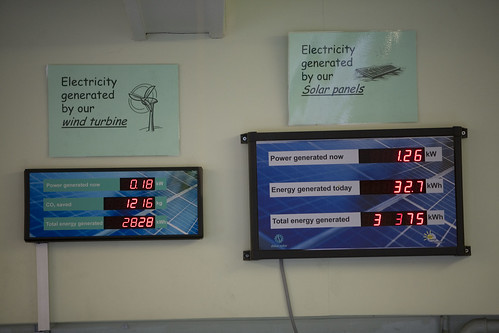
The ‘pupils’ in Owl classroom at Ashley school in Walton-on-Thames, Surrey were a bit bigger than usual on Tuesday. The year fives who usually occupy the room had given up their desks for the morning so that heads, teachers and bursars from ten schools in Surrey could attend the second of the Ashden Awards ‘LESS CO2’ workshops on becoming more sustainable.
The schools are taking part in a pilot programme of workshops where Ashden Awards staff are joined by three winners of the Ashden Schools Award to share how they made their schools more energy efficient.

Richard Dunne, head of Ashley School, Stephen Green Eco Coordinator from Ringmer Community College and Paula Owens former deputy head of Eastchurch primary all know how hard it can be to get schools and their communities on the path to energy saving – and to keep them there.
This was the second workshop and there was a real buzz in the room as school staff discussed the start they’d made on their journey to saving energy and cutting carbon. They had all carried out audits of their schools – from locating meters to assessing heating systems – and started weekly meter readings.
As well as guidance on the next steps to take, each participant received an electricity monitor which will enable them to see how much electricity they are using and monitor progress in reducing consumption over time.

Each of the Ashden award winners taking part are acting as ‘mentors’ for a group of three or four schools, available between workshops to answer questions and encourage them when things get difficult.
The next workshop will be in June when we will find out how much progress has been made.
Click here to read the rest of this post.
Subscribe to:
Posts (Atom)
