
Last week the Ashden Awards participated in the RIBA event series 'International Dialogues on architecture and climate change', arranging for three of our past UK winners to make presentations to the audience, followed by a time for questions and discussion.
The aim of the evening was for the speakers to present how, if they were the Government Minister responsible for zero carbon new buildings, they would ensure that targets for delivering zero-carbon homes by 2016 and zero-carbon non-domestic buildings by 2019 were met.
Jonathon Porritt chaired proceedings, and brought in an international element in his opening speech, telling the audience of a recent trip to Shanghai, where he saw significant progress being made on zero carbon buildings. Architects and engineers there are often frustrated by the image that China has in the West, as they actually understand a lot about how to achieve the goal of low or zero carbon building. However, Porritt also reminded the audience that new build only represents a small fraction of energy use in buildings, and that refurbishment of existing housing stock is essential. To further this, he would like to see more use of Display Energy Certificates, placing them in prominent positions in all non-domestic buildings to highlight to visitors the energy efficiency, and 'shame' organisations into improving it.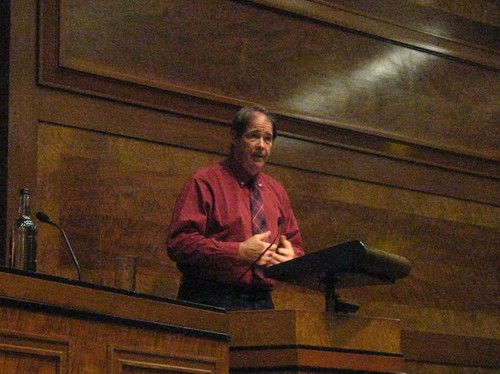
Davidson claimed that heat pumps fulfil this role, and should be mandated in all new-build situations where their use is practical, and that we should not ignore the need for cooling in some buildings, especially as this can raise the efficiency of the heat pump by using the ground below the building as a store of heat, topped up in the summer and drawn on in the winter. If heat pump demand grows as predicted, the biggest challenge facing the installation industry is making sure it can grow fast enough.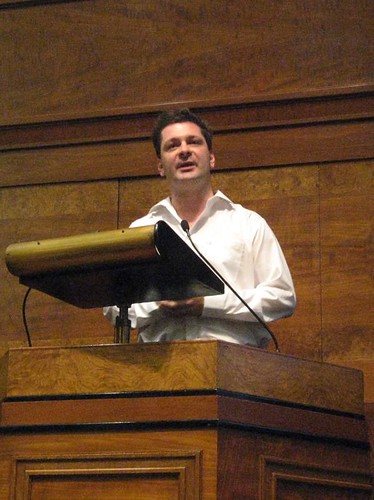
To achieve these goals, Hines proposed that government should mandate maximum kWh/m2/year usage for heating and for total energy for new buildings, and said this could be achieved through "passive design", making use of solar gain for heating and natural ventilation for cooling. Using wood in building was alsi said to be an advantage, as it locks up carbon for the lifetime of the building, in addition to avoiding the carbon emitted when producing concrete, bricks and metals. His aim overall is that the problems we face on energy consumption should not be tackled purely by the application of technology, but that buildings should be designed to avoid the problems in the first place.
However, Leggett wants solar manufacturers and installers to work more closely with architects, and believes that government needs to make FITs (Feed In Tariffs) more generous in order to persuade people to spend their own money on the technology. He felt that there is also a deeper problem in government and the civil service though - a reluctance to support micro-generation as it represents a loss of the control given through centralised systems.
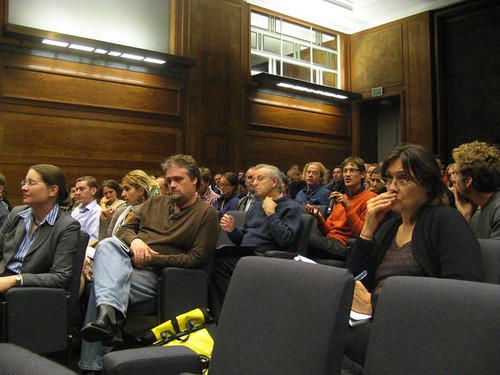
Jonathon Porritt drew the lively discussion time to a close, saying that there was no case of 'either/or', but that we needed to use all the technologies available to reduce our carbon emissions in order to meet our goal.
Sunday, 18 October 2009
Ashden Awards and RIBA: International dialogues on architecture and climate change


Tuesday, 23 June 2009
Ashden Awards blog from Jonathon Porritt
The Met Office is going to be publishing its detailed projections for the impacts of climate change on the UK today – in unprecedented geographical detail. It’s not going to be pleasant reading.Read the full blog here Click here to read the rest of this post.
So I’ve been cheering myself up by reminding myself, all over again, of the power of positive thinking. Just a week ago, the Ashden Awards for Sustainable Energy held their annual bash at the Royal Geographical Society, with the Prince of Wales handing out the Awards and giving a stirring speech.
Thursday, 12 February 2009
Ashden Awards Winter Receeption
Last week we held a Winter Reception at the Royal Society of Arts. Jonathon Porritt CBE, who is an Ashden Awards trustee and chairman of the Sustainable Development Commission, spoke at the event. He gave us his analysis of the energy situation in the UK, referring to the effects of recession and the "new green deal" brought in by President Obama.
As well as Jonathon's presentation, there was plenty of opportunity for networking, with investors, funders, past winners and Ashden Awards Circle members present. There were also displays of some of our winners' technologies, including scale models such as this sawdust-fuelled stove from KSG:
 and this treadle pump from IDE India:

Sunday, 20 July 2008
One billion trees
The latest post on Jonathon Porritt's blog covers tree planting schemes and the contribution of Wangari Maathai:
...
OK, so there are indeed a number of dodgy tree-planting schemes being done as carbon offsets, and it is now widely accepted that forestry-based offsets need to be treated with a great deal of caution. But that absolutely doesn’t mean that all tree-planting has ceased to be important.
I was powerfully reminded of this last week when the official report of the Billion Tree Campaign dropped through my letterbox. If anyone reading this piece RIGHT NOW is feeling a little bit depressed, then RIGHT NOW you should check this out http://www.unep.org/billiontreecampaign.
It’s an astonishing story. Back in 2005, the wonderful Wangari Maathai, winner of the 2004 Nobel Peace Prize (the first environmentalist ever to win) started campaigning around the idea of planting a billion trees. This was taken up by UNEP and a constellation of organisations all around the world, and duly launched in November 2006. I must say, I did wonder at the ambition level – that’s one hell of a lot of people out there planting one hell of a lot of trees.
...
Read the full post from Jonathon on his blog
