
 Since Rahimafrooz won an Ashden Award in 2006 it has continued to design and install new solar systems at an impressive rate. We recently got an update from them detailing their latest milestones. It was jam-packed with firsts.
 Rahimafrooz has now installed over 200,000 solar home systems. It has also installed Bangladesh’s first ever specially-designed flood irrigation system, its first water purification system, and its largest centralised off-grid solar system. The flood irrigation system will allow 42 farmers to irrigate 40 acres of land and enable them to grow crops three times during the year instead of once. The 8kWp solar panels use technology that tracks the sun to make best use of the eight hours of sunlight and will provide 800,000 litres of water per day.
 The cyclonic storms of Sidr and Aila, accompanied by furious tidal surges in 2007 and 2009 left people in Morelganj facing a crisis – safe drinking water. Rahimafrooz has now installed a solar-powered water purification system to provide drinking water for more than 8,000 people. The system integrates solar panels, a solar water pump and a water purification unit. Rahimafrooz is keen to replicate the success of solar-powered water purification system in other areas of the country where arsenic and salinity contaminate supplies.
 Rahimafrooz has also installed the largest off-grid solar centralised system in Barkal, Rangamati. The 10 kWp system provides lighting for the entire community living in Barkal.
Tuesday, 29 March 2011
Rahimafrooz installs more than 200,000 solar systems in Bangladesh


Friday, 18 February 2011
Solar companies consider legal challenge over subsidies
More than 20 energy companies have hired law firm Eversheds to challenge the Government's decision to review £360m in subsidies for "solar farms".
"The law firm has drafted a letter warning that many of the UK's largest solar companies are prepared to take the Government to judicial review for failing to consider all the consequences and not consulting widely enough."
Friday, 14 January 2011
Neil MacGregor shows solar lamp to Ashden Awards guests: "What people have always hoped for is now a reality"
 This week the Ashden Awards team celebrated the selection of a solar lamp and charger as the 100th object in the BBC series 'A History of the World in 100 Objects'. We were lucky enough to view the 100th object, exemplified by 2010 Gold Award winners d.light design's Nova lamp, at a reception in the British Museum.
Sarah Butler-Sloss, Founder Director, introduced the object to 100 distinguished guests, specially invited by the Awards team and members of the Development Board:
"This object is something which absolutely represents everything that the Ashden Awards stands for. In 2010 it won the Ashden Awards Gold Award. The reason for this is that it's a practical, simple and affordable object and it is available to the poorest of the poor across the globe. It replaces kerosene bringing clean, safe and bright light to households for the very first time".
The Director of the British Museum, Neil MacGregor, went on to explain how the 100th object was chosen:
"I was invited by Sarah to the 2010 Ashden Awards and, as I heard the account of what this solar panel and lamp does, and what solar panels do for people without mains electricity, setting them free, not just from the need for kerosene, but from all the political control that goes with mains electricity, all the corruption, the political interference, it suddenly became clear to me that this had to be the 100th object."
"In every society the greatest prayer is that light perpetual shine on you. And that is of course what this solar panel does, it gives you light perpetual. It lets you take the sun and use it when you need it. And we've put together some objects [in this display case] that show that through the millennia, and around the world, this is always what people have hoped for. And this is now a reality".
Wednesday, 15 December 2010
Award-winning presents for Xmas: solar lamps

D.light produces an excellent range of hard-wearing and reliable solar lanterns that are changing peoples’ lives in those parts of the world where there is no grid electricity. Instead of using smoky, dangerous kerosene lamps, people can now enjoy clean, bright light at the flick of a switch, and also charge their mobiles.
D.light Design is a ground-breaking social enterprise set up three years ago by two Stanford University graduates. It has improved the lives of over two million people in 40 countries.
Now, in response to popular demand, two of these innovative solar lanterns are available on Amazon UK, just in time for Christmas. The S250 is priced £30.00 and includes an LED light, mini solar PV panel and charger. The smaller S10 lantern is just £10.00.
See also:
Award-winning presents for Xmas: Eco Top Trumps
Award-winning presents for Xmas: energy monitors
Award-winning presents for Xmas: the cookstove
Friday, 10 December 2010
In a Senegal village, one wind turbine leads to a "building boom"
Oxfam researcher John McGrath visits a village in Senegal, well off the national grid, that has a wind turbine, towering above the baobabs, and a plane of solar panels. Cables lead off to every house and people pay any one of four tariffs, based on how much power they use. The result?
McGrath says there's a new pride, people talk about a “revival of the town”, young people who'd left for the capital are coming back, and people from surrounding areas are moving in, buying land and building houses.
McGrath writes: "A building boom was visibly in progress."
See also: Practical Action's report highly relevant to Ashden winners and Helping to lift people out of poverty also helps cut carbon emissions
Thursday, 2 December 2010
New list ranks top US states for solar energy

Ideal states should have: a relatively high level of solar insolation (ability to generate a significant amount of solar energy), a fairly large amount of economic activity resulting from solar energy being deployed, a reasonably low cost of energy installation, higher than average current prices for electricity, and the potential for electricity production through solar power that would offset large amounts of carbon emissions.
Top of the list is Hawaii (pic). California - the Sun State - only makes 30th on the list. Click here to read the rest of this post.
Friday, 26 November 2010
Three reasons why solar portable lights have a big future in Africa
A new report from Lighting Africa (above), a joint IFC and World Bank programme, says that solar portable lights could provide access to clean and safe lighting by 2015 to an estimated 65 million Africans, who are currently either un-electrified or under-electrified.
The report puts the potential for development down to three factors: significant improvement in the quality and performance of solar portable lights in the past five years; a decline in the retail price; and product features that have been adapted to meet consumer needs.
Download the full report

Friday, 12 November 2010
Chris addresses delegates from 12 sub-Saharan countries on solar and stoves
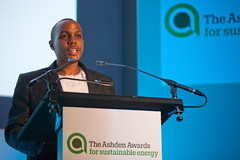
He was guest speaker at a joint international workshop in Uganda on the shores of Lake Victoria, organised by the Baring and John Ellerman Foundations.
This was a valuable opportunity for Chris to show the effectiveness of solar and stove equipment to delegates from Mauritania, Ghana, Chad, Zimbabwe, Sudan, Ethiopia, Tanzania, Democratic Republic of Congo, Kenya and, of course, Uganda.
The purpose of the week had been to share experiences of working with displaced peoples and focus on women, rights and education. Chris wrote to us:
I am mainly going to talk about two challenges - indoor air pollution and lack of access to electricity. I will then share with the delegates some of the technologies available to deal with these challenges (efficient cook stoves and solar energy), the benefits gained from using these technologies (better health, income generation and saving and environmental conservation) and I will share with them the approach that Rural Energy Foundation has taken to diffuse these technologies (market development).
The Rural Energy Foundation won the 2010 Ashden Award for Africa, which was supported by the John Ellerman Foundation.
Update - Chris comments on the response: "A lot of interest was shown by the delegates. It was really eye opening for them, especially the statistics on the deaths caused by smoke and indoor pollution and the lack of access to electricity in Africa. They were also surprised about some of the new technologies which are more affordable like the D.light Kiran and the Barefoot Power Firefly...I've even received an invitation from one of the organizations that attended to talk about the same subject".
Wednesday, 10 November 2010
Harish says, "Look at the need, tailor the product"

"Providing bright light really impacts so many facets of people's lives. It essentially extends their day. It allows them to work for longer hours and more productively. It lets children study longer."
Harish Hande of SELCO says:
"In the traditional, top-down methodology, it's a one-sided supply chain, where the product goes down to the poor. We go from the opposite side. We look at what the need is, then tailor the product to the need."
Monday, 8 November 2010
Antiques Roadshow ends with thoroughly modern 100th Object
 Last night’s episode of the Antiques Roadshow, which took place at the British Museum, ended by highlighting Radio Four’s 100th object.
The show’s panel of experts pitched in with their own ideas for a 100th item that represented the modern age. There was the SatNav: “nothing has done more for domestic harmony”. There was the pair of rubber clogs: “They’ve changed my life at the seaside". And there was the microchip: “I’ve never seen it, I don’t know how it works, but it has changed everybody’s lives.”
Neil MacGregor on what the 100th object teaches us
Nick Stern says solar power can free communities from corrupt practices,
In one hour from the sun, we get enough energy for a year,
100th Object introduces us to “the noise of the day",
100th object reminds us of extraordinary amount the semiconductor transistor has done for 21st century life
100th Object going "to change the way we think",
After today's 99th Object, one more to go,
From 100th Object to 100s of solar projects,
What the Twitterverse thinks of 100th Object,
100th Object: "a story worthy of this generation",
Solar-powered lamp revealed as 100th Object,
Tomorrow’s vote on 100th Object keeps solar in the news,
Solar lamp an icon in social entrepreneurship
and
Will solar powered lamp be 100th Object?
Friday, 5 November 2010
Neil MacGregor on what the 100 Objects teach us

"Once you have seen that different societies can organise themselves in different ways, the inevitable conclusion is that social order is contingent and therefore changeable. That totally transforms the role of the citizen, doesn't it? The citizen can change his polity, and then the consequences for society are enormous."
Nick Stern says solar power can free communities from corrupt practices,
In one hour from the sun, we get enough energy for a year,
100th Object introduces us to “the noise of the day",
100th object reminds us of extraordinary amount the semiconductor transistor has done for 21st century life
100th Object going "to change the way we think",
After today's 99th Object, one more to go,
From 100th Object to 100s of solar projects,
What the Twitterverse thinks of 100th Object,
100th Object: "a story worthy of this generation",
Solar-powered lamp revealed as 100th Object,
Tomorrow’s vote on 100th Object keeps solar in the news,
Solar lamp an icon in social entrepreneurship
and
Will solar powered lamp be 100th Object?
Wednesday, 3 November 2010
Zardari sees opportunities in Pakistan for 'massive investment' in renewables

He advised the authorities concerned that all the new houses being built in the rural areas of Sindh under Behan Benazir Basti Programme should be provided with solar or wind power. The president also said new street lights should be solar/LED-based, billboards and electronic power-based neon signs should be converted to solar, and special industrial hubs set up in the coastal areas of Sindh and Balochistan based on the wind power harnessed in these areas.
Tuesday, 26 October 2010
South Africa plans biggest solar plant in world
South Africa unveils plans for world's biggest solar power plant. Giant mirrors and solar panels in Northern Cape would reduce carbon emissions and generate one-tenth of the country's energy needs. The government says the Northern Cape province is among the sunniest 3 percent of regions in the world with minimal cloud or rain.
Click here to read the rest of this post.Sunday, 24 October 2010
100 objects in 5 minutes with solar lantern at 4 mins 50 secs

For those who missed the series, you can watch the five-minute version here, with the solar lantern coming in seconds before the end.
If you have more than five minutes, you can read our other posts here:
Nick Stern says solar power can free communities from corrupt practices,
In one hour from the sun, we get enough energy for a year,
100th Object introduces us to “the noise of the day",
100th object reminds us of extraordinary amount the semiconductor transistor has done for 21st century life
100th Object going "to change the way we think",
After today's 99th Object, one more to go,
From 100th Object to 100s of solar projects,
What the Twitterverse thinks of 100th Object,
100th Object: "a story worthy of this generation",
Solar-powered lamp revealed as 100th Object,
Tomorrow’s vote on 100th Object keeps solar in the news,
Solar lamp an icon in social entrepreneurship
and
Will solar powered lamp be 100th Object?
Friday, 22 October 2010
Nick Stern says solar power can free communities from corrupt practices

I’ve been aware of the impressive health and economic benefits of off-grid solar lamps. But what struck me this morning from Lord Stern’s comments was the idea that solar energy can bring political empowerment.
“One of the great things about solar power is freedom from the grid. In many parts of the world, particularly the developing world, particularly South Asia and Africa, it is extremely unreliable.
It's one more way that solar energy allows people within rural communities to take control over their own lives.
In one hour from the sun, we get enough energy for a year
Nicholas Stern, author of the Stern Review, explains to Neil MacGregor the potential of the solar panel and why we are on the verge of a new industrial revolution.
"One of the great advantages of solar energy is that as far as we humans are concerned, it's almost limitless. Why? Because in one hour we get as much energy from the sun on the earth as we use right across the planet in one year. And further, the cost of accessing that limitless supply of energy is really crashing down. Just in the last couple of years, the cost of a solar panel has fallen by about half."
100th Object introduces us to "the noise of a new day"

Today's programme rightly stressed the importance and benefits that solar energy can bring to the 1.6 million people without access to electricity, in terms of improvements to health, education and livelihoods. It also made clear the freedom and independence that this technology brings.
But what the programme brought us, most of all, was a really fresh and exciting perspective. It was very powerful to hear Nicholas Stern say that we are at the start of a new industrial revolution. It was also fascinating to hear how myths from around the world show how humans have always dreamt of storing energy from the sun.
100th object reminds us of extraordinary amount the semiconductor transistor has done for 21st century life
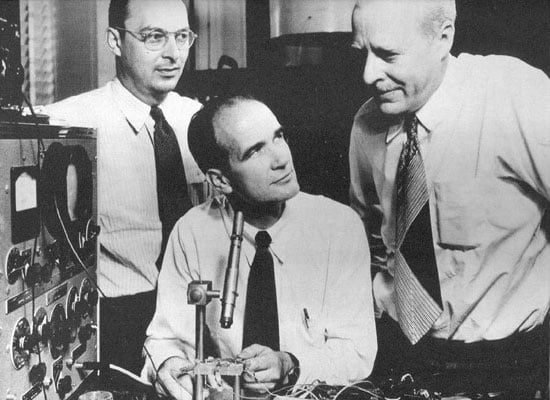
Neil MacGregor couldn’t have made a better choice for his 100th object than the solar panel with lamp and charger, not just for what it does, but for what it stands for.
The solar cell is the younger sister of the semiconductor transistor, the key invention that started the semiconductor industry. For me, the solar panel stands for all the science and technology which has gone into the semiconductor industry, providing the computers, mobile phones, communications and entertainment that are 21st century life.
Already solar cells are powering crucial parts of the semiconductor world, from communications satellites to lamps and chargers. And now there are real signs that solar will move from niche to bulk power supply.
pic: John Bardeen, William Shockley and Walter Brattain won the Nobel Prize in Physics in 1956 for their invention of the semiconductor transistor.
See also 100th Object going "to change the way we think", After today's 99th object, one more to go, From 100th Object to 100s of solar projects, What the Twitterverse thinks of 100th Object, 100th Object: "a story worthy of this generation", Solar-powered lamp revealed as 100th Object, Tomorrow’s vote on 100th object keeps solar in the news, Solar lamp an icon in social entrepreneurship and Will solar powered lamp be 100th object?
100th object going "to change the way we think"

A History of the World, or AHOW, has not focussed on the history of conflict, or the clash of personalities, but on the history of things, how things influence one another, and how those things have changed the way we live. It's global, generous, and disarming.
The statistics bear this out. Half of the 10 million downloads have been from outside the UK.
At the very start we learnt about the Olduvai stone-chopping tool (picture) the oldest humanly-made object in the British Museum. The choice of the solar-powered lantern is entirely consistent with that early choice. Last week, Neil MacGregor said the idea of capturing the sun is:
"the oldest myth of every culture in the world. You can take the sun and use it whenever you want. The myths in Ancient Egypt, and every culture, are now reality ... We felt that this was a kind of tool that – like the stone chopping tool – is really going to change lives, to change the way we think and the way we are."
Thursday, 21 October 2010
After today's 99th object, one more to go
The 96th object in A History of the World in a 100 Objects was a Russian Revolutionary plate. The 97th object was a David Hockney print showing two men in bed. The 98th object was the Throne of Weapons made out of guns. The 99th object was a credit card.
Tomorrow at 9.45am, and then again at 7.45pm, the British Museum's director Neil MacGregor will discuss the 100th object, the solar-powered lantern, and the future of renewable, non-polluting energy that has the potential to liberate the developing world.
On this blog tomorrow, we will have comments about the broadcast from Ashden Awards' founder director, Sarah Butler-Sloss, senior adviser Anne Wheldon, and other members of the Ashden team. We'll also round-up what others are saying on blogs and tweets about the 100th Object.
See also From 100th Object to 100s of solar projects, What the Twitterverse thinks of 100th Object, 100th Object: "a story worthy of this generation", Solar-powered lamp revealed as 100th Object, Tomorrow’s vote on 100th object keeps solar in the news, Solar lamp an icon in social entrepreneurship and Will solar powered lamp be 100th object?
