

Yesterday's post asked whether the UK could encourage a shift in energy use through the feed-in-tariff. Yes, says Mike Pepler, our UK awards manager, it could help balance out energy use.
Peak demand in the UK during the winter is between 5pm and 7pm (see pic above and the half-hourly live table here ). We need to even out energy demand throughout the day, regardless of whether or not households install renewables. At some point we could all be paying different electricity prices depending on time of day we use the energy. A tool in the feed-in-tariff to incentivise 'smart consumption' is therefore a step in the right direction.
But we have to watch out that such incentives don't deepen imbalances within society. One point I’ve heard raised by people working to tackle fuel poverty is that people in poverty can’t afford the new appliances to take advantage of electricity prices that vary according to time of day. If we moved towards time-sensitive pricing, they would miss out on the savings. Not only that, but the current feed-in-tariff is actually subsidised by all electricity consumers, but only those installing micro-renewables get the benefit.
These disadvantages don't mean we shouldn't have a feed-in-tariff. We need new generation capacity to reduce CO2 and to keep the lights on. Since that's in everybody's interest, you could say it's fair we all pay a bit to make it happen. But we must also be realistic about what solar can do. We will need other sources as well, and storage too.
Friday, 7 January 2011
Yes, the feed-in-tariff could shift the way we consume energy


Thursday, 6 January 2011
Could the UK follow Germany’s lead in changing feed-in-tariffs to get us to use our own energy ?
 An article in Renewable Energy World today picked up on a tool that's been brought in by the German government to incentivise those people who have installed micro-renewables to change the pattern of their energy consumption.
The German feed-in-tariff not only encourages PV installation, it also encourages "own-consumption". The government will pay those who have installed solar more money per kWh hour for the energy they consume themselves.
This new incentive addresses the fact that people with solar panels produce energy during the day when the sun is out and yet they consume it in the evening when they are home from work (see graph above). The new policy could encourage more people to use smart appliances that switch on during the day. It could also make people more aware not just of what energy they are using, but also when they are using it.
Is this a policy that might work in the UK?
Tuesday, 12 October 2010
Solar lamp an "icon in social entrepreneurship"

These range from the iPhone ("epitomises our hyper-connected reality") to the washing machine ("liberated western women from domestic duties") to the plastic water bottle ("symbol of our wastefulness").
The solar-powered lamp is one of the four (out of five) contenders that have so far been selected by the series makers for the shortlist.
One of the most recent comments on the BBC's blog - from Elaine Khoo in Singapore - supports the specific example of the D.light solar-powered lamp.
it is an icon of the gravitational shift of social entrepreneurship - the focus of designing for consumers at the bottom of the pyramid which even the Fortune 500s are scrambling to get right.
One of this year's Ashden Award winners, D.Light has already sold over 220,000 units in over 30 countries via a network of rural entrepreneurs.
The 100th object will be announced on Thursday.
Will solar-powered lamp be 100th object of the world?

On Radio 4 this morning, the Today presenter Evan Davis inspected "a plastic and metal object that's about 15 centimetres by 10 centimetres".
As long as the sun shines, this object provides. It’s a life-changer and not just for a few of us. It could alter and secure the existence of billions.
The other three contenders to have been nominated are: a football shirt, a mobile phone and Antarctic clothing. The 100th object in A History of the World in 100 Objects will be announced on Thursday.
Monday, 20 September 2010
Mike visits The Recycled House
Mike Pepler, our UK Awards Manager, went to help out at an Old Home SuperHome open day. The programme is organised by the Sustainable Energy Academy, which won an Ashden Award in 2009, and includes over 50 homes open to visitors at various points during the year. The SuperHome that Mike helped at is The Recycled House, Camber, East Sussex.
The Recycled House has 2.1 kW of solar PV panels on the roof, feeding surplus electricity into the grid, and 7 m2 of solar thermal panels. The large amount of solar thermal is intended to provide a portion of the space heating during cold but sunny weather. It feeds into a 450 litre thermal store, up in the loft, which is also heated by an efficient woodburner.
The store supplies hot water and also runs underfloor heating on the ground floor. The upper floor has no heating - it is so well insulated, with external insulation as well as cavity wall insulation, that it should not need it - some heat will drift up from downstairs anyway.
Here's the owners, John and Helen: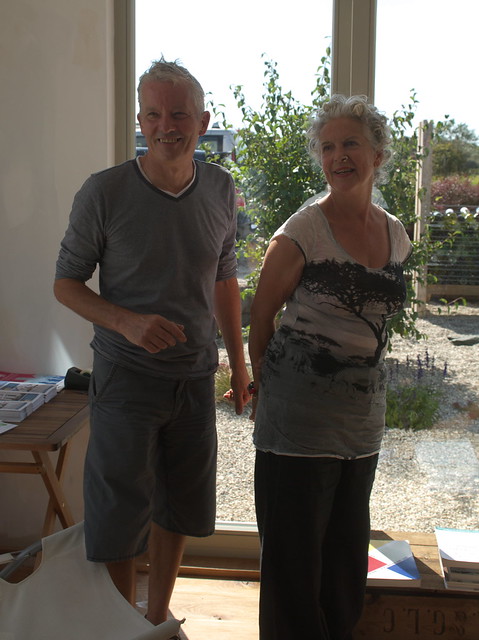
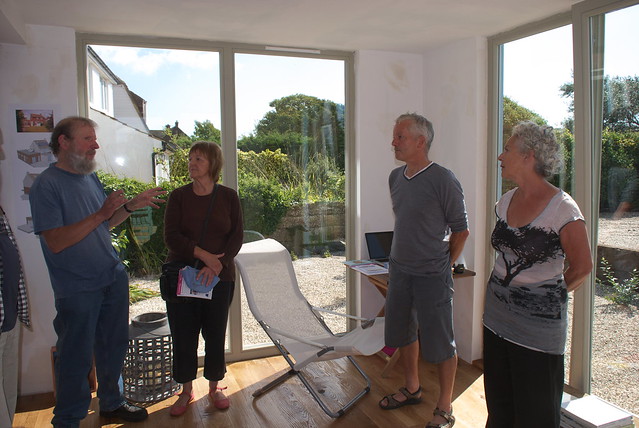
The weekend was busy, with almost 70 visitors over the days it was open, including neighbours, passers-by who saw the solar panels and the sign announcing the open day, and people who'd travelled specially to see what they'd done.
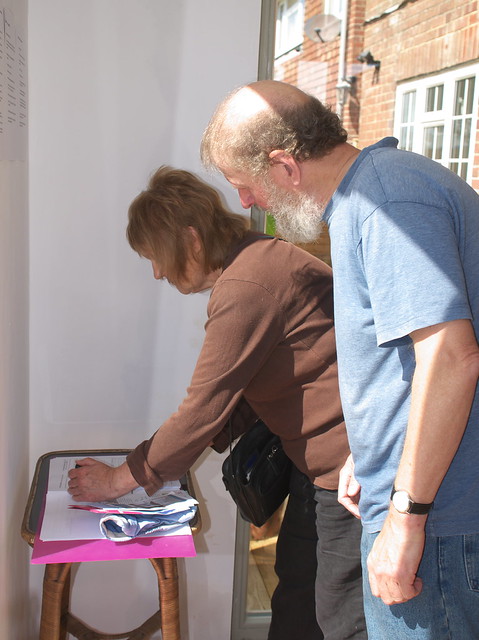
As each person left, they completed a survey to find out what they thought of the open day, and whether they were going to take action to reduce energy use in their own home as a result of visiting. This is one of the ways in which the Sustainable Energy Academy measures the impact of the programme.
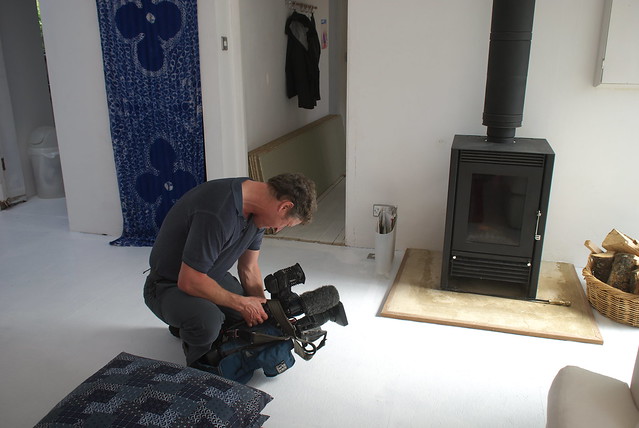
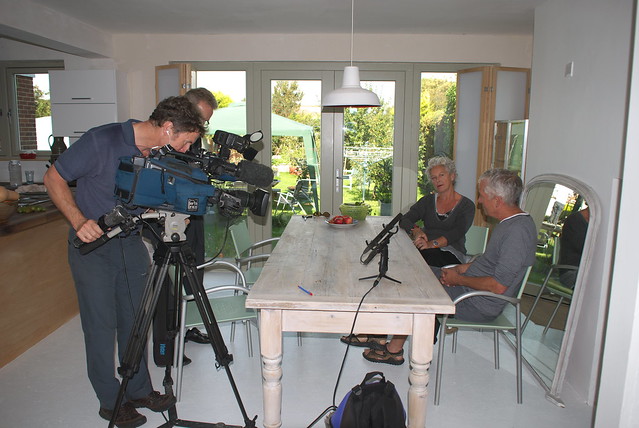
There were some other visitors as well: a film crew from ITV Meridian News were doing a feature on "eco homes", which will go out in a couple of weeks. The cameraman took a range of still shots, including one of the woodburner:
and they also interviewed John and Helen to find out about their motivations and achievements.
To find out more about the Sustainable Energy Academy's Old Home SuperHome programme, visit the Ashden Awards website. To find out more about John and Helen's house, go to The Recycled House.



Friday, 22 January 2010
Solar PV in Laos
In 2007, Sunlabob won an Ashden Award for their work with solar PV in Laos. In 2009, they were awarded a World Bank funded procurement project, and have made a new video about their work:
You can also watch our own video about Sunlabob:
Tuesday, 12 January 2010
Easy Like Water - Bangladesh
In 2007, Shidhulai Swanirvar Sangstha won an Ashden Award for their work with boats using solar power to provide education, healthcare, lighting and other services to people in Bangladesh.
Now, the Sundance Institute is producing a film about them, called Easy Like Water. Here's a trailer they have released:
You can also watch the Ashden Awards film from 2007:
Tuesday, 5 January 2010
Ashden Award winners in the news
A couple of recent stories from the Times of India:
Sunshine on his shouldersRead the full story here
A decade ago, rose pickers in a village near Bangalore would go clumsily about their job in the early morning hours, a basket in one hand and a lamp in the other. It was hell on bent backs. Today, they work for longer hours and with both hands free, in fields lit by solar power. The man who harnessed the sun for them is Harish Hande, 41, managing director, Selco, a company specialising in reaching cheap solar energy to those who need it. Selling over 80,000 installations of photovoltaic (PV) solar-home-systems that provide lighting and are suitable for radios and fans since 1995, Hande has proved that one can wed business with social responsibility. Linking solar lighting to income generation, Selco employees went doorto-door listening to the needs of potential customers and explaining how a few hours of extra light after sunset could lead to more earnings, fewer fumes from gas lamps, and more study time for kids.
A ray of lightRead the full story here Click here to read the rest of this post.
The timing couldn't have been better. As Union environment minister Jairam Ramesh was reiterating India's commitment to a low-carbon economy at Copenhagen on December 7 last year, his colleague, new and renewable energy minister Farookh Abdullah, was inaugurating a 2 MW, zero-carbon footprint solar power plant in Jamuria, Asansol. Incidentally, it once used to be an abandoned thermal power plant with a high carbon foot print.
"It sent a strong message that India is empowered in green energy," says S P Gon Chaudhuri, an engineer and the man behind this green transformation. Chaudhuri has been tapping solar energy for lighting up villages across east India since the time when global warming looked like a distant threat and carbon footprints figured only in science journals
Friday, 13 November 2009
The real agenda for Copenhagen is tackling poverty

Poverty is the greatest threat to our environment. The poor use some of the most inefficient technologies and polluting fuels - not because they are cheap but because they don’t have a choice.
Today’s debate on the climate change treaty is seen as between the developed world and the developing world. It has led the rich in developing countries to hide behind the poor and the poor in developing countries to be short changed. The reality is we all have a vested interested in getting this treaty right – rich and poor.
We have before us a wonderful and unique opportunity – to implement climate change solutions that will also reduce poverty, like affordable solar energy systems. My social enterprise, Selco India has provided 112,000 solar home systems to low income households and institutions. We ensure that the systems are affordable by partnering with microfinance organisations that provide small loans. We have also set up a pilot fund to guarantee the deposits on solar systems for very poor families. Nothing can compare with the thrill of someone switching on a light for the first time and knowing how this can change their life!
Much, much more of this can be done and we are showing just what's possible. If we partner with the poor to create options for them to produce their energy sustainably – be it through renewable energies or clean stoves or biogas – we will get a double whammy: a curb on climate change but also a route for them out of the relentless poverty trap.
We must put poverty at the centre stage of Copenhagen and not focus on the false confrontation between developing versus developed world. When the discussion finally turns towards providing sustainable energy solutions for the poor a new dawn of social justice and economic progress will begin.
Read more Voices on Copenhagen
Selco Solar Light designs and sells solar home systems, primarily to meet the needs of the poor. The company was winner of the Outstanding Achievement Award from the Ashden Awards for Sustainable Energy in 2007 and a 2005 winner.
View the Ashden Awards video of SELCO:
Friday, 7 August 2009
More YouTube videos about IDEI and SELCO
Many of our Ashden Award winners also get involved with other organisations to help publicise and expand their work. Here's a couple of videos from Youtube.
IDEI, who won an Ashden Award in 2006, and an Ashden Outstanding Achievement Award in 2009, have also been working with the Skoll Foundation. Here's a video about their work:
SELCO, who won an Ashden Award in 2005, and an Ashden Outstanding Achievement Award in 2007, have been working with media organisations, such as Deutsche Welle, Germany's English-language international broadcaster, who made this film:
In case you'd never seen their original Ashden Awards films, here are the two for IDEI:
and the two for SELCO:
Friday, 24 July 2009
Solar Energy Foundation on BBC
Solar Energy Foundation (Stiftung Solarenergie), a 2009 Ashden Award winner, had an article on the BBC News website earlier this month:
Two years after the installation of a solar power project funded by international aid groups, villagers in northern Ethiopia say the sun's energy has turned their lives around.
...
"We've had solar energy for over a year now. We're very happy because we're saving money. Altogether we have eight children, and for our kids at school the solar energy is great."
 Read the full story here
Click here to read the rest of this post.
Read the full story here
Click here to read the rest of this post.
Monday, 6 July 2009
Bangladesh – at the front line of climate change
Paul Rose, BBC presenter and expedition leader is a highly supportive Ashden Award ‘Advocate’ who helps raise awareness of the work of our winners. Paul has just returned from a trip to Bangladesh visiting sustainable development projects and witnessing at first hand the country’s vulnerability at the front line of climate change. One of the highlights of the visit was spending a few days with Rezwan who runs an amazing project bringing solar energy to remote waterside communities with a fleet of boats. Shidhulai Swanirvar Sangstha was an Ashden Award winner in 2007, working in Chalanbeel, a region flooded in the monsoon season (when Paul was there!). The boats’ roofs are covered in solar panels that charge batteries for the solar systems they carry to local communities. They provide education for the local young people, particularly girls, training on agriculture, health advice, mobile phones and internet access.
 In the evening, films are projected onto a sail to educate villagers. Some boats also act as mobile health clinics where women queue up to access services they cannot get elsewhere. As Rezwan explained to Paul, Bangladeshis will probably have to live on the water if climate change continues at the present rate as the whole country could be flooded. It’s essential that this approach to reducing the social and environmental vulnerability of communities is expanded.
 Paul filed stories every day for the BBC news website which provide a fascinating and colourful insight into the communities he visited.
BBC online stories
Paul’s blog
Tuesday, 26 May 2009
Powering our way out of poverty
2007 Outstanding Achievement Award winner, Harish Hande of SELCO, has written an article on the BBC News website
As the world's leaders consider how to finance our battle against climate change, the financing of practical, affordable solutions for poor people in countries like my own, India, appears to be of little interest.Read the full story here Click here to read the rest of this post.
It is nearly 130 years since Thomas Edison gave us the electric bulb, yet more than two billion people on this planet still do not have the luxury of electricity.
Up to 50% of households in India still have no access to modern lighting. Millions of street vendors, whether in the hi-tech city of Bangalore, India, or Kampala, Uganda, still resort to kerosene or candles to sell their meagre wares.
Thursday, 7 May 2009
Bangladeshi ventures aim to build solar PV industry
Stories appearing in the Bangladeshi media indicate that plans are afoot to create a capacity for solar panel manufacture in the country over coming years. Companies are vying with each other for a share of the action.
Two of the Ashden Award's previous award-winners - Grameen Shakti and Rahimafrooz - are key players in rolling out solar power in Bangladesh and are mentioned in the plans.
The Financial Express article "Bangladesh-US venture to build country's first solar plant" says the move by Star Group to build a solar plant comes as solar power makes inroads in a vast swathe of rural areas left untouched by the national electricity grid, achievements that Grameen Shakti has played a large part in, backed by soft-loan refinancing schemes by IDCOL.
In the article, the MD of Rahimafrooz, which sells batteries to the charities, said the plant would speed up the growth of solar systems in the country. He said Rahimafrooz is also pursuing its own plan to build a photovoltaic panel factory, as he sees Bangladesh emerging as a top solar-powered nation within a few years.
"Solar power systems are changing the face of rural Bangladesh. And it would be a billion dollar industry within a few years," he said.
The article in The Daily Star focuses on IDCOL's plan to establish solar plants, in collaboration with partners such as Grameen Shakti. They currently import panels from India and China.
More info:
Financial Express Bangladesh
Daily Star article
Daily Star opinion on sustainable energy
Monday, 16 March 2009
LCBP support for solar runs out
A recent report from the Renewable Energy Association says:
The Renewable Energy Association, representing the renewables industry, expressed astonishment and concern at the closure of Stream 2 support for PV under the Low Carbon Building Programme (LCBP).Read the full story here Click here to read the rest of this post.
Only four days after the Government laid out plans for a low-carbon revolution, at the launch of its new low-carbon industrial strategy, it announced that the funding stream for the most popular technology, solar power, had run out. No applications made since the 26 February are permissible and the whole stream is due to end in June.
In December last year an extra £7 million was allocated to the PV stream of the LCBP to tide it over until the programme closed. However this funding had all been allocated by the 26 February 2009. A further £12 – 15 million still remains in the LCBP budget and at the present rate of spend it is predicted that £8 million will remain unspent by the end of the programme. The Department of Energy and Climate Change (DECC) have said that Phase 2 will not be extended and any remaining funds will be sent back to the Treasury.
The REA recommends the immediate reallocation of remaining LCBP funds on a first come, first served basis so all microgeneration technologies can gain maximum benefit.
Tuesday, 17 February 2009
Ashden Awards past winner gets Zayed Future Energy Prize
Grameen Shakti, who won an Ashden Outstanding Achievement Award in 2008, have now been awarded the inaugural Zayed Future Energy Prize. Dipal Barua accepted the prize of $1.5m, saying:
“It is a great honour to receive this recognition inspired by the vision of HH the late Sheikh Zayed, I consider myself a global Ambassador of the Prize, and would like to carry forward the message of environmental sensitivity that is being championed by the leadership of Abu Dhabi.”You can read more on the press release section of the Zayed website. Click here to read the rest of this post.
Monday, 2 February 2009
Ashden Awards winners in the Independent
A couple of articles featuring Ashden Awards winners have been published in the Independent recently. The first is about how Zara Solar has brought solar PV lighting to Tanzania:
Developing solar power in Africa is being eagerly pursued by international organisations including the World Bank and the United Nations and a host of smaller NGOs such as the UK’s Ashden Awards, a sustainable energy initiative whose support was the catalyst for the spread of the technology through northern Tanzania. In 2007 Ashden awarded £30,000 to a local solar entrepreneur, Mohamedrafik Parpia, to expand his fledgling business and investigate ways of helping the very poorest Tanzanians access the systems. In just three years, Parpia’s business Zara Solar has fitted nearly 4,000 systems, providing electricity to a much greater number. Click here for the full storyThe second is also based on Tanzanian organisations, this time the Kisangani Smith Group, who have developed domestic stoves that can burn waste sawdust, and MRHP, who use crop waste to fire bricks:
The stoves are made from a sheet of metal which is lined with clay. Sawdust or other agricultural residues are then used as fuel. Cooking with biomass in this way dates back to the discovery of fire, but that does not make it primitive. “I kept watching the carpenters throw away sawdust,” says Reuben Mtitu, whose grandfather set up the blacksmith workshop he now runs to provide skills and employment for local young people. “I wondered why they wasted so much, and started to think of ways we could put it to good use instead.” Click here for the full storyClick here to read the rest of this post.
Monday, 19 January 2009
New SELCO blog
SELCO, who won Ashden Awards in 2005 and 2007 for their work in solar powered lighting, have just launched a new blog that their employees will contribute to. You can read it here:
http://selcomment.blogspot.com
Monday, 29 December 2008
Global solar report card
Global Green USA and Green Cross International have published a "Global solar report card", which they say:
"... explores 16 countries, and the state of California’s, solar commitments to date, as well as their policy efforts in fostering future growth of their solar markets. Success stories as well as lessons learned in policy implementation are discussed. Final grades reveal that all countries are still in the early phases of solar deployment."You can download the report here. Click here to read the rest of this post.
Monday, 22 December 2008
Solarcentury at Poznan
Solarcentury, who won an Ashden Award in 2007, joined with other solar companies and the United Nations Environment Programme (UNEP) at Poznan to encourage rapid expansion of the use of solar PV technology to combat climate change, as reported by Your Renewables News.
Their proposal included:
Jeremy Leggett, Executive Chairman of Solarcentury, said: "As a European leader in building-integrated solar, Solarcentury expects to see buildings routinely becoming power plants in the years ahead, generating all their own electricity and heating needs in situ, and often more than they need, making them net exporters of energy. With the right partners in the construction industry, we can put up zero-emissions buildings in a matter of weeks: not the years that conventional power plants require. We are seeing some excellent progress with European support, particularly with the incentive of strong feed-in tariffs, but we need very much more."
Read the full story here.
