
 ENWORKS won an Ashden Award in 2007 for outstanding energy efficiency advice to businesses. Five new local reports demonstrate the impact its resource efficiency programme has had in areas across the Northwest.
In Cheshire and Warrington over 1,200 businesses have been helped through the programme, saving them 18.7m per year. For example, through the support of an ENWORKS advisor from Groundwork Cheshire, the Ellesmere Port headquarters of Protocol Skills, a national vocational training provider, has saved £7,100 a year by reducing boiler settings, setting up a weekend switch-off regime, installing water saving devices and low energy lighting and establishing a switch off campaign.
Property coordinator, Nick Biglowe, said:
“Other companies are missing out. A lot of people don’t realise how some really simple changes can make a huge difference. There’s no catch with Groundworks Cheshire – everyone benefits."
The reports also reveal that companies in Cumbria have saved 70,000 tonnes of CO2 through efficiency measures, whilst over 6,000 jobs have been saved across Lancashire, Liverpool and Greater Manchester.
(pic: CHK in Crewe, a steel components manufacturer, has saved £17,300 to date through efficiencies)
Wednesday, 16 March 2011
Five new reports show efficiency measures bring jobs, savings and CO2 reductions for businesses across the Northwest


Friday, 28 January 2011
Government warns UK firms to make better use of resources
 A major report, published by DEFRA, explains the need for UK firms to factor resource issues into their long-term decision-making and to find alternatives to the materials they now use. We recently highlighted that one of our past winners, ENWORKS, is helping businesses do just that.
Business Green reports:
“According to the research ... a wide range of materials will face constricting supplies over the next few decades as the global population rises towards an estimated nine billion by 2050. [T]he report warns that the supply of rare earth elements is likely to be particularly constricted. Companies will have to increase recycling rates and make better use of metals such as indium (a component in solar panels), as well as cobalt and lithium (elements in electric car batteries and solar cells).”
Todd Holden, ENWORKS director, says small and medium-sized enterprises (SMEs) are often aware of the importance of resource efficiency, but this doesn’t often translate into action:
"Our own independent research on business attitudes, which surveyed businesses of all sizes, but focused on SMEs, has found that 82% of businesses felt that resource efficiency was 'very important' or 'of some importance' to them. Yet, crucially, only 33% had made efficiency improvements in their use of energy, materials or water in the previous 12 months, and only 20% were planning to do something about it in the following 12 months.”
It's clear more could be done. The financial savings alone make this self-evident. DEFRA’s report states that energy efficiency measures could save British companies more than £6bn a year.
See also: ENWORKS shows that resource efficiency can save your business
Tuesday, 25 January 2011
In current financial climate, ENWORKS shows that resource efficiency can save your business
 Juliet Heller speaks to Samantha Nicholson, Operations Manager of ENWORKS about its successful Online Resource Efficiency Toolkit, which helps businesses across the North West to make cost savings. In the current financial climate, it couldn't be more useful.
ENWORKS won an Ashden Award four years ago for demonstrating that good environmental practice in businesses is profitable. Since then, their business support has gone from strength to strength. The support that ENWORKS provides has helped businesses in the North West save over 669,000 tonnes of CO2 a year, and generated savings of over £120 million a year. Since the Toolkit was launched in 2004, it has supported over 8,700 businesses of all sizes, in the North West and further afield.
The Toolkit is part of ENWORKS' wider resource efficiency programme. Samantha explains:
“We immediately remove a lot of the barriers to businesses that haven’t embarked on the sustainability journey so far. This isn’t a report or manual that sits on a shelf gathering dust, it’s an easy to use electronic tool that allows busy staff to manage large amounts of detailed data across several projects, and it’s continually updated to align with the latest national research on CO2 calculations."
"The toolkit also helps managers who are facing resistance to adopting environmental measures to build a stronger internal business case. The data provides them with the pros and cons of specific measures, both in a financial and environmental sense.”
There could be a growing demand for this approach in the UK. A recent Carbon Trust survey of finance directors found that big businesses wastes £1.6 billion a year on energy that could be saved through easy measures, such as upgrading heating and lighting, and carrying out staff training in energy saving. The research found that energy efficiency projects could deliver an average return on investment of 48%. The average payback period on large-scale business investments in energy efficiency is only three years, the report says, but many straightforward improvements cost little or nothing at all. Over half of the cost savings, that ENWORKS helps implement, are made at no capital cost. Samantha adds:
“We are working with an amazingly diverse range of businesses including manufacturers, haulage companies, hotels and leisure centres and healthcare organisations, just to give a flavour. We have enough data now to demonstrate clearly that the Toolkit is helping businesses make huge savings and we are happy to share our knowledge and expertise with others, for example through tools such as our ENWORKS In a Box site. We hope more and more businesses will recognise the value and economic sense of increasing their resource efficiency”.
In the current financial climate, the efficient use of resources such as energy, water and materials can make the difference between losing or saving your business.
(pic: Samantha Nicholson with ENWORKS director Todd Holden)
Monday, 17 January 2011
Architype's Jonathan Hines explains why the "passivhaus" approach works best
Jonathan Hines from Architype, an Ashden Award winner in 2009, talks to Juliet Heller about designing buildings that are affordable, look good, and use less energy.
Architype puts this approach into practice by focusing on passivhaus techniques. Passivhaus is a rigorous approach to building, designed to radically reduce energy consumption and achieve maximum internal comfort. Passivhaus buildings save carbon simply by using less energy. Architype has recently designed two passivhaus schools in Wolverhampton which will be completed this summer. They will be the first in the country.
Jonathan Hines: "The beauty of passivhaus is that it's not about ticking boxes, it is a design tool that really works. You can aim to build a low-carbon building by adding renewables but find that the technology doesn't perform as well as you'd hoped in practice. With passivhaus you know that it works, it will get the energy down lower, and it will last for the long term".
"In the current climate of austerity measures, designing buildings well to save energy is the way to go, not spending more money on technologies that just offset carbon".
"We should be setting energy targets for buildings instead of carbon targets. This would encourage people to design buildings that use less energy in the first place, instead of relying on offsetting. The concept is an obvious one but so important: Buildings need to be designed better to improve their energy efficiency".
(pic: Jonathan Hines outside Architype's office, built to high standards of energy efficiency, constructed largely using wood and based on an existing barn).

Monday, 10 January 2011
Save energy, save money: insulate your loft
 Mike Pepler, our UK awards manager, continues his new series Save Energy, Save Money with a look at loft insulation.
Unless you live in a flat that's not on the top floor, the roof accounts for about a quarter of the heat loss from your home. Insulating the roof can reduce the heat loss by up to 50%, saving energy and saving you money. There are several different types of roof, and different ways of insulating them - we'll look at the most common types now...
Pitched roof with a loft
This is the typical design of roof in the UK, with sloping tiles covering a loft space above the top floor of the house. The floor of the loft will be wooden joists, with the ceiling of the top floor of the house underneath them. Often you'll find boards have been laid over the joists to provide storage space in the loft.
The most common way of insulating a loft like this is to use rolls of glass fibre, which is laid between the joists and then on top of them. Having insulation over the top of the joists is important, as usually they are only 150mm (6") deep, and the recommended minimum insulation is 270mm (11"). If you already have boards laid down over the joists, you can either put 270mm of insulation on top of them, or remove them and proceed as normal. Whatever you do, it's important not to block any gaps at the edge of the loft that are intended to provide ventilation, otherwise you could get damp problems.
But I need my loft for storage space!
If you can't do without your loft for storage space, there are two options. One is to use insulating polystyrene boards, which can be cut to fit between the joists and then the floorboards can be put over the top. This works because the insulating boards perform better than glass fibre, so the thickness can be reduced by up to 50%, depending on the type of board used. However, these insulating boards cost more. The other option is to lay glass fibre between the joists and then screw down new joists at a right-angle:
insulate between them:
and put the boards on top:
If you do this, make sure the joists are strong enough to take the extra weight of wood, in addition to what you plan to store in the loft. Also, remember not to block up any ventilation gaps.
Don't forget the loft hatch
The hatch into the loft should also be insulated. How this is done will depend on your hatch, but if it is a simple panel that you push up from underneath, then you can glue an insulation board onto the back of it:
Savings and costs
A loft insulated with 270mm of glass fibre (or an equivalent insulating panel) will reduce heat loss by 50% compared to a loft with no insulation. Even if you already have some insulation, it will still be worth increasing it to the recommended minimum. Glass fibre insulation typically costs £3 per square metre to insulate to a depth of 270mm. Insulating boards typically cost £15 per square metre at 80mm thickness, but the thickness you need to use will vary according to the type of board.
Professional installation of insulation in a standard loft will typically cost £250 for glass fibre, although in most cases there are grants available to reduce this cost.
Compared to having no insulation, you might save about £150 a year by adding 270mm of glass fibre. If you already have some insulation, say 50mm, then upgrading to 270mm will save £45 a year.
Dormer roof with loft
A dormer roof is one that has tiles extending down to the top of the ground floor, with the upstairs windows extending through it, with a small flat roof above them.
The main part of the loft, towards the top of the roof, can be insulated in the same way as a normal loft, but the lower sections of the roof enclose another loft area that is often inaccessable. This part can be insulated by making a hatchway in the wall of a first floor room, allowing insulation to be installed in the small loft area alongside the wall. As with the main loft, you must be careful to avoid blocking any gaps that are required for ventilation of the roof space.
Flat roof
Flat roofs are often found on ground floor extensions and above the windows in a dormer roof. Insulating these roofs requires more work, as either the ceiling must be taken down inside the house, or the roofing material lifted above the room. Once the cavity is exposed, it can be insulated as normal using glass fibre or insulating boards. Boards may be a better option here if the space is limited. As flat roofs must be renewed every 15 to 20 years, it is usually worth waiting until this renewal is being done before installing insulation.
Pitched roof with a room in the loft
If you've converted normal loft space into a room, it's very important to insulate it, as otherwise there's not much between the room and the cold air outside. In this case, insulation boards must be used, and fitted between the rafters before plasterboards or other material is put in place. It may not be possible to use the ideal thickness of insulating boards, and the rafters between them will reduce the effectiveness, but the insulation is still worth doing, cutting heat loss and saving on energy bills.
Getting loft insulation installed
Unlike cavity wall insulation , loft insulation is something that you can often install yourself, although many people choose to pay for it to be done professionally.
One of the easiest ways to find a reputable installer in your area is to contact your local council, as they will be able to recommend one to you and also help you with grants. Alternatively, you can contact the Energy Saving Trust for advice or look at consumer rated websites such as YouGen.com.
What if I live in a block of flats?
If you live in a ground or middle floor flat, you may still gain from insulating above your ceiling, for example if the flat above is unoccupied, and therefore colder than your flat, but the savings will not be as significant. If you live on the top floor, loft insulation should be installed as normal.
Ashden Award winning loft insulation
Several Ashden Award winners have worked with loft insulation, you can view them in our case study database. Of particular interest is Second Nature , who make an insulation product from sheeps' wool, called Thermafleece (pic at the top: Thermafleece being installed courtesy of Thermafleece.com).


Sunday, 19 December 2010
UK National Grid issues first Gas Balancing Alert of the winter
This evening the National Grid in the UK issued the first Gas Balancing Alert for the 2010/11 winter. The latest status for gas supply can be viewed on their information website.
According to the National Grid:
The purpose of the Gas Balancing Alert (GBA) is to provide a signal to the market that demand-side reduction and/or additional supplies may be required to avoid the risk of entering into a Network Gas Supply Emergency.The issuing of this alert is therefore a signal to the gas market in the UK that action needs to be taken to ensure security of supply, and in the past this action has always been successful. The action is typically large industrial gas users reducing their consumption, or new short-term supplies being acquired, either from gas storage or through extra imports.
So what does this mean for gas and electricity consumers in the UK? Domestic supply will be guaranteed, but prices will inevitably be pushed up further still. Gas prices will rise as a direct result, but also electricity prices, as over 40% of our electricity is generated by burning gas.
What can you do? Well, you could start by reading some of our past blogs on how to save energy and therefore save money:
Nine solutions that work to combat rising fuel prices
Save energy, save money: cavity walls
What should we be doing as a country? The standard industry and government response is to build more pipelines or LNG import terminals - but building facilities does not guarantee there will be gas flowing through them, as that depends on the market and the suppliers. It also doesn't help the UK balance of payments, or help cut CO2 emissions. While extra import facilities may be useful, the first action that must be taken is to reduce consumption through demand management and efficiency, as we mentioned just last week on this blog.
Mike Click here to read the rest of this post.
Friday, 17 December 2010
Existing Homes Alliance advises Green Deal: benefits would mean less CO2, more local jobs & lower energy bills
This month, the government introduced the Energy Bill into Parliament as part of its new Green Deal. The Existing Homes Alliance also recently published recommendations to ensure government efforts help the UK to refurbish its existing housing stock – to bring it in line with the UK’s commitment to cutting carbon emissions 80% by 2050.
Their recommendations cover key areas of the Green Deal. The first is finance: policies must allow the most to be made from the economic opportunities of widespread refurbishment – estimated between £5-15 billion. Secondly, the Existing Homes Alliance stresses that the government must place attention on how the work will be done - by investing in tradesmen and exploring area-based schemes for example - and done well. Shoddy work will make a dent in consumer demand for these changes. Thirdly, the government needs to focus on driving demand, regulating minimum energy performance is a necessary ‘stick’, but ‘carrots’ are also important.
Simon, our UK Business Support Manager, also works with the Existing Homes Alliance. He thinks making these changes will stimulate wider benefits:
"Creating demand for uptake of energy efficiency measures and stimulating the behaviour change that is needed to meet our carbon reduction targets is a tall order – but we can learn a lot from many of our Award winners who have worked hard to engage local communities, help them understand the issues, and take action. If, as a result of rising to this challenge, we get more local jobs, a more buoyant local economy and lower energy bills, then everyone wins."
(Pic: House on the right has been refurbished, including external wall insulation, by 2010 Award winners Northwards Housing)

Thursday, 16 December 2010
Best Ashden Moments 2010: Simon picks the publication of Power to our neighbourhoods

For me one of the best moments of 2010 was the publication of our research in June which was a culmination of a year's work and contained the wisdom of many of our UK winners.
The report drew on current best practice to demonstrate how we can cut energy bills, reduce CO2, create jobs and help secure our energy future by scaling up and replicating local sustainable energy programmes.
The work has been well received and is having a direct impact on UK policy.
Briefing paper
Executive summary
Full report
Monday, 13 December 2010
The idea that Britain can either have clean energy or cheap energy ignores the third option: saving energy
There are some fairly uncomfortable facts in the Economist's latest article on energy in the UK, Clean and green for a price.
One is that Britain ranks 3rd lowest out of 27 European countries in producing renewable energy (one above Malta and Luxembourg). Another is that renewables account for 3% of total energy consumption at the moment, and the government has signed up to an EU target to reach 15% by 2020. A third is that Britain pays £1 billion a year in subsidies for renewables.
But the Economist article frames the situation in the narrow terms of either/or. The intro sums it up: Britain can have clean energy or cheap energy, but not both. But there is a third option that the Economist has ignored. What about energy efficiency and managing energy demand?
Mike Pepler, our UK awards manager, says,
"Savings are vital and there's a difference here between demand management and energy efficiency: efficiency is switching from a big car to a small car for the commute to work; demand management is working from home instead."
It takes time for renewables to come on stream and, since we don't have the luxury of time, it puts an added emphasis on behavioural change. This means that the most sensible order in which we should tackle the energy challenge is: (i) reduce demand (ii) improve efficiency and (iii) use renewables. As Mike says,
Doing things in this order delivers the quickest and cheapest savings, but it puts the responsibility on individuals to make decisions to change the way they live - which is the way it probably should be.
Wednesday, 1 December 2010
Award-winning presents for Xmas: energy monitors

The OWL energy monitor, and similar gadgets like the Efergy, are really easy to use, but beware, they are quite addictive. I gave one to my partner a few years ago and he’s obsessed with it. He checks the temperature and electricity consumption several times a day. But I mustn’t complain. It’s cut our electricity bills by 25%.
Then I gave one to my nephew Max for his 16th birthday (really, he asked for one). Max likes gadgets and enjoys fixing electrical equipment. Now he’s Mr Energy Monitor around the house too, and is using the OWL for a school project that studies why rooms in the house are different temperatures.
Jo, our Head of Communications, says she's a compulsive OWL watcher at home.
“It’s been quite an education. I was amazed to see how electricity use surges when one of us switches on the kettle or the vacuum cleaner. And it’s great for checking if things are left on, which often happens with young children (and forgetful husbands)."
Jo encourages schools to get a monitor as the first step towards sustainability. The Ashden Awards runs a project called LESS CO2 (Low Energy Sustainable Schools) which motivates school leaders to reduce their energy consumption by working with some of our award-winning schools.
An energy monitor hasn't in itself won an Ashden Award, but OWL electricity monitors, for instance, allowed households on the Isle of Eigg to keep an eye on how much power they are using, and many schools who have won our awards, such as St Columb Minor School in Cornwall and Ringmer Community College in East Sussex, use energy monitors to track energy consumption and reduce electricity use. The teachers also use the data in maths and science lessons, which helps integrate climate change learning across the curriculum.
Another, more sophisticated tool, the Eco-Driver software programme is used by Ashley C of E Primary School in Walton on Thames to monitor the energy generated by their solar PV as well as their energy consumption. It helped reduce the school’s electricity use by 50 per cent in the first year.
The BBC News says the next generation of smart meters
“should cut electricity consumption by around 5%, so if all Brits used one the emissions savings would be roughly equivalent to taking 600,000 cars off the road.”
OWL monitors are available on Amazon for £25. It’s worth reading the reviews.
Tuesday, 2 November 2010
This Sunday you can visit Juliet's SuperHome
 Last week we reported in how to turn a small, cold, dark house into a superhome on how Juliet, Ashden's Media and PR Manager, had transformed her three-bedroom Edwardian terrace house in Essex.
Her local paper, Maldon and Burnham Standard, devoted two pages to the story and quoted Juliet, saying:
"We want people to see how warm and comfy the house is and that you don't have to spend loads of money."
Now people can see for themselves. This Sunday Juliet and her partner Ian Daglish (pictured) are opening their SuperHome in Wycke Lane, Tollesbury to the public between 11am and 3pm. More info: juliet@julietheller.co.uk
Friday, 29 October 2010
Mike set to save £500-£600 on gas and electricity
The story so far: three years ago Mike Pepler, our UK Awards Manager, and his wife Tracy, bought an eight-acre wood. This year they bought a house. Now they are heating the house with the logs from the wood.
Since this is the last day of Energy Saving Week we've asked Mike to update us on progress, now he's been in his new house a few weeks. It's going so well, he reckons this year he'll save more than £500 on gas and electricity bills.
Mike writes:
We’ve had our woodburner and solar thermal installation running for a month now, and the loft insulation has been complete for a few weeks as well, so how’s it going?
The good news is that the house certainly isn’t cold. After a bit of experimentation we’ve figured out how to set the stove to burn slowly overnight when it’s cold, and then in the morning there’s a few embers glowing so it can be quickly got back up to full heat if it’s needed.
We’ve found that as the house faces almost south, there’s a lot of solar gain on sunny days, reducing the need to light the woodburner, even on relatively cold days.
The solar thermal is working well, getting the tank up to 70C on sunny days, and pre-heating the water at the bottom of the tank to 30C even on somewhat cloudy days. Combined with the heat input from the stove, there’s been no shortage of hot water.
We’re pleased with the way the heat from the stove is circulating through the house, both by convection and using the radiators. Although the main thermosyphon (or gravity) loop is to the hot water cylinder and bathroom radiator, quite a bit of heat can also thermosyphon to the radiators, which are all controlled by thermostatic valves. This has meant that we haven’t needed to turn on the central heating pump.
Now that we’re only using gas for the hob on the cooker, daily usage has dropped to under 1kWh, which should lead to an annual bill of £25 at most.
When it comes to electricity, the main guzzlers in the house are the fridge and freezer, although both are A+ rated. We chose a “larder fridge” (i.e. no ice box), as this improves efficiency a lot, and our freezer is a slimline version that opens on the top, as this is much more efficient than having a door on the front, which lets the cold air spill out every time you open it. All our lighting is low-energy CFL bulbs, and our computers are energy-efficient laptops. Oh, and we don’t have a TV, though we do use the BBC iPlayer. The upshot of all this is that our electricity usage so far has been a bit over 3kWh a day, so annual usage will hopefully be between 1200 and 1500 kWh, resulting in an annual bill of around £200.
Overall, if our gas and electricity costs come in at a bit over £200, this will be significantly less than the average of perhaps £7-800 for a household like ours.
Of course, we still need to get the wood for our woodburner, and although we’re not buying that, we do have to work hard to get to it, but at least that’s something we enjoy. We’re currently cutting wood for use in two year’s time, after it’s properly seasoned. It’ll be great to see the trees we’re coppicing now growing back next year as well.
Wednesday, 27 October 2010
How to turn a small, cold, dark house into a SuperHome
 As part of Energy Saving Week, Juliet Heller, the Ashden Awards Media and PR Manager, writes about moving to Essex and converting an Edwardian terraced house that had felt "small, cold and dark" into an officially-accredited SuperHome. The aim was to show how green an old house could be.
The story so far
The eco scheme
The house met our main criteria: it required a complete refurbishment and it had a South facing aspect.
Typically Edwardian, the main house has a square footprint with a two storey rear addition. The ground floor was divided into a living room, dining room and kitchen with a 60s extension at the rear to house a bathroom and toilet. It felt small, cold and dark, but that was soon to change dramatically.
 The refurbishment project was managed by Ian, who's an experienced building contractor with an engineering background and longstanding interest in sustainability. Ian’s aim was to contradict a prevailing belief that older properties could not be “green” and demonstrate that they could be made super energy efficient - at an affordable price.
The scheme for the house involved re-designing the ground floor to make it completely open plan, and installing extensive glazing on the rear, to bring more light and warm sun into the house. It also included a loft conversion to accommodate a guest room and office.
The house was planned and equipped to be as energy efficient as possible, using insulation, renewable energy and smart environmental design. Within four months the refurbishment was complete and the three of us moved into an attractive, light and spacious new home.
Creating a ‘SuperHome’
We undertook a range of measures to reduce the carbon impact of the house:
Solar thermal gain: passive solar gain occurs when a house benefits from the internal heat generated by the low sun during winter months. The open plan design and installation of glazing on the South facing elevation heat the house through the natural power of the sun, at zero cost.
Efficient wood burning stove: the wood burning stove is integral to the scheme. The original chimney breast was widened to allow for a 10 kilowatt convection stove. With the open plan design, its heat radiates and warms the whole house, and the temperature can be regulated by opening or closing bedroom doors. Only seasoned, locally-sourced hardwoods are used.
Solar hot water: solar panels on the kitchen roof are South-facing and during April to October they provide at least 90% of the household’s hot water.
Insulation: insulation was installed during the loft conversion thus removing a large cold area within the house. Unusually for a property of its age, the house had cavity walls. Once this had been established, all four houses in the terrace were able to benefit from cavity wall insulation.
Electricity consumption: all domestic appliances are A-rated for energy efficiency and clothes are dried outside. The majority of the lights throughout the house are low energy, and less efficient overhead halogen lights are used as little as possible. We track the energy consumption with an OWL energy monitor, switching off lights and appliances when they are not needed.
Secondary heating: an oil condensing boiler (there is no gas in the village) was fitted for back up heating and hot water but is not required during summer months. At colder times of year the wood stove, passive solar gain and solar water heating heat the house and water.
Water: as 30% of domestic water consumption goes down the pan, a dual flush toilet was a must. The family opts for showers instead of baths as they consume a fraction of water. An unforeseen benefit was a sealed well in the back garden previously used to supply the terrace for domestic needs and is now used to water the plants.
What are the benefits of a low carbon home?
 The house is warm and comfortable to live in, as well as bright and airy thanks to the building design and the harnessing of the natural heat of the sun. It also requires very little electricity, water and fuel, as the yearly bills confirm. With such low electricity and water use, the utility companies were initially regularly in contact to check whether the meters were accurate!
The combination of the wood burner acting as the household’s primary heat source, and the use of solar hot water, annual heating bills have been slashed by more than 75% compared with an equivalent house.
More to do
Next year we hope to install high-efficiency sash windows and a new sealed front door to further draught-proof the house.
Another aim is to replace all overhead halogen lighting in the living area and loft with efficient LED lights.
What is a “SuperHome”?
Having reduced its CO2 emissions by 62%, in 2009, the house achieved SuperHome status from the Sustainable Energy Academy and National Energy Foundation who together run the Old Home SuperHome Project, an alliance of exemplar low carbon homes across the UK.
Each SuperHome has been assessed for a range of energy efficiency criteria and found to have reduced its carbon footprint by over 60% compared to an equivalent home of its age and size. SuperHome owners hold regular open home days to encourage other home owners to take energy saving steps, helping the UK move towards its target to cut carbon emissions by 34% by 2020.
About us
Ian Daglish is a building consultant specialising in sustainable building refurbishments, with over 20 years’ experience as a building contractor. He has studied for an MSc in sustainable building from the Centre for Alternative Technology, the world’s leading centre for pioneering sustainable technologies.
Tuesday, 26 October 2010
Energy Saving Week: Ashden winners tackle energy-saving in businesses
It's Energy Saving Week, and we're highlighting how Ashden winners are saving energy. Yesterday we looked at community-based initiatives, today it's energy-saving in businesses.
Ashden winners have been helping businesses to save millions and cut carbon emissions. ENWORKS in the North West has worked with over 10,000 companies since 2002. By helping businesses to use its online resource efficiency toolkit, it can show how new installations, changes in manufacturing processes, or behaviour changes, can impact on carbon emissions and competitiveness. ENWORKS is currently helping businesses with annual cost savings of £117 million and savings of 855,000 tonnes of CO2 emissions per year.
Global Action Plan (GAP) encourages behaviour change within the workplace by enabling businesses to develop their own energy-savvy teams called ‘Environment Champions’. Usually, around 20 staff work with GAP to understand where and how energy is used within the company, before creating a plan for tackling it.
We especially like the energy bike which GAP loans to companies for awareness-raising events (pic). You get to feel - through the burn in your thighs - just how much energy it takes to light a bulb, run a laptop or play an ipod. GAP has worked with over 70 companies and trained 1,200 people, influencing 86,000 staff and saving around 9,300 CO2 tonnes a year.
You can find out about the energy saving work of all of our Award winners from our website. Tomorrow we'll be hearing from members of the Ashden team who are saving energy by refurbishing their homes.
More on Energy Saving Week
Obama says energy efficiency will get US "quarter of the way"
Ashden winners tackle energy saving in the community
This week is Energy Saving Week

Three simple energy-saving steps could save £2 billion
The latest research for the Energy Saving Trust claims that UK householders could save more than £2 billion every year by taking three simple energy-saving steps.
The report says that if every UK householder that was able to went and insulated their cavity walls and lofts up to 270mm, replaced old fashioned bulbs with compact fluorescent light bulbs (CFLs) and turned their appliances off standby, owners would not only save hundreds of pounds a year on their fuel bills but also cut nearly 10 million tonnes of CO2, equivalent to taking almost 3.5 million cars off UK roads.
More on Energy Saving Week
Obama says energy efficiency will get US "quarter of the way"
Winners tackle energy saving in the community
This week is Energy Saving Week
Hat-tip: Edie.
Obama says energy efficiency will get US "quarter of the way there"

So my approach to Republicans would be to say, "Regardless of what you think about climate change, here are a bunch of things that are smart to do. It will save consumers money, it will save the country as much money going into foreign oil imports, so let’s concentrate on things that we just know are smart to do." If we do that, we can probably get a quarter of the way there in terms of where we need to be in terms of carbon emissions.
Monday, 25 October 2010
Energy Saving Week: how Ashden winners tackle energy saving in communities
This week is Energy Saving Week, so it's a good time to ask the question: how do you stimulate change across communities and businesses to make real reductions in energy use?

Ashden winners have been grappling with this issue and producing innovative results. Take the 2010 winner Isle of Eigg Heritage Trust, an impressive example of community-led change. The Trust was bought out by the community in 1997, and its efforts have led to a staggering 47% reduction in energy use.
Tomorrow we profile two Ashden winners who work to reduce the energy use of businesses. Over the rest of this week, we’ll be writing more about the experiences of members of the Ashden awards team who are retrofitting their homes.
See also: A trip to the Isle of Eigg
Wednesday, 20 October 2010
Energy efficiency now key consideration for new homes
More than three quarters of home owners say energy efficiency is a key consideration when looking for a new home. It had once been a "neutral issue", but now “energy efficiency is creeping up the wish-list for house buyers”.
See also Siberian swans focus minds on winter
Mike insulates the roof
Monday, 4 October 2010
New website reports on how the arts in the UK are going green
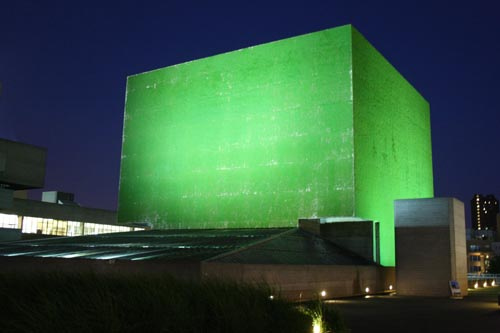 The website Sustainable Ability is a new arts project that aims:
to help drive forward transformative responses to resource scarcity and climate change from individuals and organisations working in the arts.
It is intended as another point of connection in the growing network of support designed to help the UK’s cultural and creative sector.
Sustainable Ability has just launched a report by Hilary Jennings and Lucy Neal on the cultural sector's response to climate change, along with a Google map of activities, the findings of a survey, and a useful list of additional resources.
For organisations and websites in the UK working in this field, see also: Julie's Bicycle, Tipping Point, Cape Farewell, Arcola, Do The Green Thing and - closer to home - Ashdenizen. See also what the National Theatre is doing to reduce its energy consumption.
Arts institutions should note that the Ashden Awards 2011 welcomes applications from the public sector: from fire stations, hospitals and colleges to theatres, galleries and museums.
Pic: Lyttelton Flytower by Ackroyd and Harvey
Update: Science foundation provides $700,000 to theatre company for climate change play Click here to read the rest of this post.
Friday, 1 October 2010
Last night's pub quiz on cookstoves

For more on stoves: Stoking up a cookstove revolution (Ashden Awards)
See also: Global Alliance for Clean Cookstoves and Hillary Clinton calls clean cookstoves a "cross-cutting issue"
And for some Ashden award-winning stove projects, go to: TWP/AHDESA, GERES Cambodia and Aprovecho/SSM. Click here to read the rest of this post.
