
Simon Brammer and Carla Jones travelled to Cornwall last Thursday for a conference on sustainable schools, organised by Ashden award-winner Gill Harper from St Columb Minor School and partly funded using Ashden Awards prize money. Carla Jones reports:
There were over 100 delegates representing schools throughout Cornwall for the conference ‘Developing Sustainable Schools in Cornwall’. It was also good to see representatives from past Ashden winners - Community Energy Plus and Solarcentury - among the exhibitors.
Rachel Delourme from Cornwall Learning introduced the opening speeches from Simon Brammer and Sharon Longden, Head of Cornwall Learning, which laid out the challenges and opportunities for schools (see the Ashden's learning resource for schools).
The explorer Anthony Jinman told us how achieved his dream of reaching the North Pole by the age of 29. Now, as founder of Education Through Expeditions, he reports on the dramatic climatic changes he sees in the polar regions through an interactive learning website.
Ben Margolis, acting director at 10:10, emphasised that real change won’t be driven by delegates at Copenhagen and Cancun, but will instead come from sustained engagement with local communities, starting with schools. It is at this grassroots level that people get a sense of agency and push for change.
The conference shared best practice in schools. We heard about the new pupil-led teaching approach at Ashley Primary School, the wide-ranging sustainability measures that have been introduced at St Columb Minor, and the fresh adventurous attitude to cooking at Penair School, where last week octopus risotto was on the menu.
Finally, we had a lot of interest in the next LESS CO2 programme that will support schools across the Southwest to reduce their carbon emissions.
(pic: Pupils taking wind speed readings at St Columb Minor School)
Monday, 14 March 2011
100 delegates meet in Cornwall to discuss sustainable schools


Sunday, 18 October 2009
Ashden Awards and RIBA: International dialogues on architecture and climate change
Last week the Ashden Awards participated in the RIBA event series 'International Dialogues on architecture and climate change', arranging for three of our past UK winners to make presentations to the audience, followed by a time for questions and discussion.
The aim of the evening was for the speakers to present how, if they were the Government Minister responsible for zero carbon new buildings, they would ensure that targets for delivering zero-carbon homes by 2016 and zero-carbon non-domestic buildings by 2019 were met.
Jonathon Porritt chaired proceedings, and brought in an international element in his opening speech, telling the audience of a recent trip to Shanghai, where he saw significant progress being made on zero carbon buildings. Architects and engineers there are often frustrated by the image that China has in the West, as they actually understand a lot about how to achieve the goal of low or zero carbon building. However, Porritt also reminded the audience that new build only represents a small fraction of energy use in buildings, and that refurbishment of existing housing stock is essential. To further this, he would like to see more use of Display Energy Certificates, placing them in prominent positions in all non-domestic buildings to highlight to visitors the energy efficiency, and 'shame' organisations into improving it.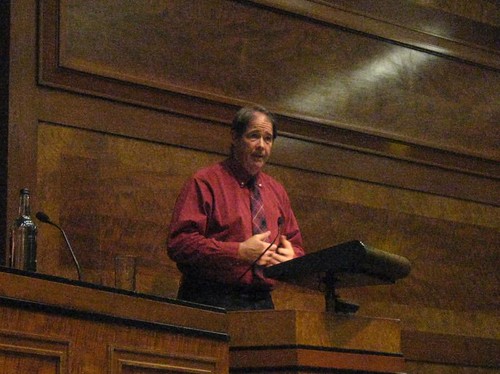
Davidson claimed that heat pumps fulfil this role, and should be mandated in all new-build situations where their use is practical, and that we should not ignore the need for cooling in some buildings, especially as this can raise the efficiency of the heat pump by using the ground below the building as a store of heat, topped up in the summer and drawn on in the winter. If heat pump demand grows as predicted, the biggest challenge facing the installation industry is making sure it can grow fast enough.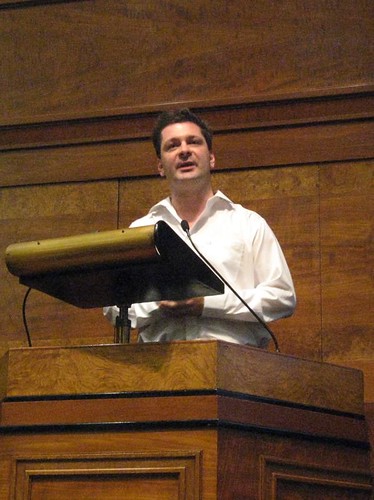
To achieve these goals, Hines proposed that government should mandate maximum kWh/m2/year usage for heating and for total energy for new buildings, and said this could be achieved through "passive design", making use of solar gain for heating and natural ventilation for cooling. Using wood in building was alsi said to be an advantage, as it locks up carbon for the lifetime of the building, in addition to avoiding the carbon emitted when producing concrete, bricks and metals. His aim overall is that the problems we face on energy consumption should not be tackled purely by the application of technology, but that buildings should be designed to avoid the problems in the first place.
However, Leggett wants solar manufacturers and installers to work more closely with architects, and believes that government needs to make FITs (Feed In Tariffs) more generous in order to persuade people to spend their own money on the technology. He felt that there is also a deeper problem in government and the civil service though - a reluctance to support micro-generation as it represents a loss of the control given through centralised systems.
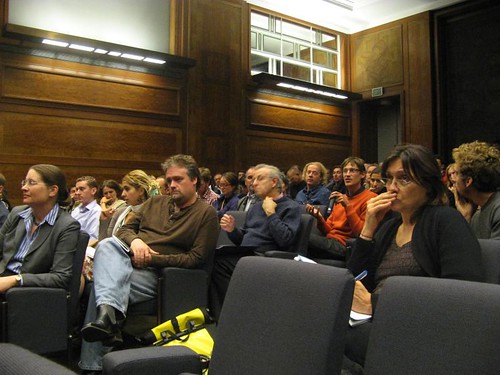
Jonathon Porritt drew the lively discussion time to a close, saying that there was no case of 'either/or', but that we needed to use all the technologies available to reduce our carbon emissions in order to meet our goal.

Wednesday, 9 September 2009
Oil still has us over a barrel
Jeremy Leggett, CEO of SolarCentury, one of the 2008 Ashden Awards winners, speaks out in his regular column for The Guardian about his concerns over peak oil and puts the latest oil finds in the Gulf of Mexico and other areas of the world into perspective. Based on an oilfield-by-oilfield study by the International Energy Agency (IEA), he argues that oil supplies are still depleting at an alarming rate, at a time when demand is also increasing, particularly in countries like India and China: “the IEA sees the potential for a global oil-supply crunch within just five years”.
Read the full story here.
Friday, 24 July 2009
New website from Jeremy Leggett, Solarcentury
Jeremy Leggett, founder of Solarcentury, a 2007 Ashden Award winner, is not just known for his work with solar power. He has also worked in the oil and gas industry, and also fro Greepeace, so is well qualified to speak on issues such as Climate Change and Peak Oil.
These subjects are covered on his new website: www.jeremyleggett.net, with sections on peak oil, the problem of coal, solar power, nuclear power and also topics such as corporate social responsibility and investing.
One of the main features is the "Triple crunch log", which documents the events of the past few years of the energy, climate and financial crises. Latest highlights are included on the relevant pages, and the entire log can be downloaded if you want to read the full story.


Monday, 22 December 2008
Solarcentury at Poznan
Solarcentury, who won an Ashden Award in 2007, joined with other solar companies and the United Nations Environment Programme (UNEP) at Poznan to encourage rapid expansion of the use of solar PV technology to combat climate change, as reported by Your Renewables News.
Their proposal included:
Jeremy Leggett, Executive Chairman of Solarcentury, said: "As a European leader in building-integrated solar, Solarcentury expects to see buildings routinely becoming power plants in the years ahead, generating all their own electricity and heating needs in situ, and often more than they need, making them net exporters of energy. With the right partners in the construction industry, we can put up zero-emissions buildings in a matter of weeks: not the years that conventional power plants require. We are seeing some excellent progress with European support, particularly with the incentive of strong feed-in tariffs, but we need very much more."
Read the full story here.
Tuesday, 9 September 2008
Solarcentury Youtube page
Solarcentury, one of our 2007 winners, have their own Youtube page with several videos, such as this introduction to solar PV:
