

“Among all the challenges facing humankind in the twenty-first century, few are more pressing than climate change and global warming. Unfortunately ... most of the climate debate so far has been gender-blind."
“Today, women in India are becoming agents of change through their own initiative, their energy and enterprise. Through individual and collective action, they are transforming their own situations and indeed transforming the broader social context itself ... India is at the cusp of a ‘demographic dividend’, due to its young and increasingly educated and skilled population. Imagine what might happen when this demographic dividend is multiplied by a ‘gender dividend’. It will, I believe, yield enormous economic gain and lead to profound social transformation."
Full lecture here.
Monday, 21 March 2011
Sonia Gandhi says most of climate debate has been "gender blind"


Friday, 18 March 2011
Red noses support Wangari's Green Belt (among other things)

In the intervening years, other issues have risen in prominence, including climate change. In 2006, Comic Relief commissioned research to understand better the impact of climate change on the world's poorest. The research made clear that the world's poorest were facing a climate change "triple whammy":
"they didn't cause it, they are most affected by it, and are least able to afford even simple measures that could protect them from the damaging impacts that are already unavoidable."

Professor Maathai was the keynote speaker at the Ashden Awards in 2008.
Wednesday, 19 January 2011
The IEA's chief economist Fatih Birol says the unsayable

The BBC's environmental analyst Roger Harrabin reported on this morning's Today programme (3 mins in) that Dr Birol said it would take "a doubling of the current effort and then another doubling again". Harrabin remarked that Dr Birol "had said the unsayable".
Even BP agrees.
Tuesday, 11 January 2011
Jeremy Leggett argues that Queensland floods show interconnections between financial, climate and energy crises

In the last month, we have seen interconnections between the financial-, energy- and climate crises very clearly ...
One example he gives is that:
massive investments have gone into coal, based on prospectuses prepared by the same investment banks whose dire risk management gave us the financial crisis, factoring in not a dime of risk from the climate crisis. But we ignore such risk at our peril, as coal miners in Queensland have discovered lately. Their flooded mines have meant big losses in export income, and coal shortages overseas which themselves have knock on impacts ...
BBC latest: Brisbane braces for surge
Pic: Karumba, Queensland
Tuesday, 7 December 2010
Helping to lift people out of poverty also cuts carbon emissions

Martin, an Ashden Awards judge, says there's no reason you can't tackle climate change and energy poverty simultaneously.
Indeed, you will struggle to do one without the other. Pretty much every energy technology which helps lift people out of poverty – clean, efficient cookstoves; clear bright solar lights; and, in the developed north, a crash programme of energy efficiency for vulnerable homes – will also cut carbon emissions.
Friday, 26 November 2010
The Economist backs renewables as "a matter of justice"
 The Economist's cover story today is: How to live with climate change. The paper says, 'It won’t be stopped, but its effects can be made less bad.' Climate change also provides
an extra reason for rich countries - which caused the problem in the first place - to find ways to help poor countries develop. That is a matter of justice, not just humanity.
The paper argues that prosperity is the best protection against global warming, but it recognises that as economies grow they consume more energy, which threatens to make the problem worse.
... rich countries can help, by offering poor countries support for greener energy technologies, and thus allowing them to make use of their capacity for generating renewable energy from water, wind and sunlight.
pic: Alamy/Corbis
Thursday, 11 November 2010
This evening's live webinar on campaigning and climate change

"The public is going to be asked to change energy use in profound ways."
"The evidence suggests that public engagement with climate change is pretty limited."
The next speaker Chris Rose, communications consultant and author of How To Win Campaigns contrasts reflexive and reflective thinking, and maps out society in terms of prospectors, settlers and pioneers. Rose says:
His advice? "Start from where people are - don't try to change minds by changing values."
"If you start by thinking you want to win an argument, it's almost always the worst way."
(Slides and recording of this Earthcast available 10am tomorrow.)
Monday, 8 November 2010
Live blogging and tweeting the webinar on climate change
This blog has signed up to the webinar about campaigning and climate change on Thursday at 5pm (London time). Topics include:
Different roles the public can play in tackling climate change
Behaviour change strategies for encouraging sustainable lifestyles and communities
Messages about climate change that engage the public (and those that don’t)
The speakers on "Pre-COP Communicating Climate Change" are Chris Rose, environmental campaigner and communications consultant, and Lorraine Whitmarsh, lecturer in Environmental Psychology. We'll be blogging and tweeting the webinar from 5. Join in.
Thursday, 4 November 2010
Geological Society says emitting more CO2 "likely to be unwise"
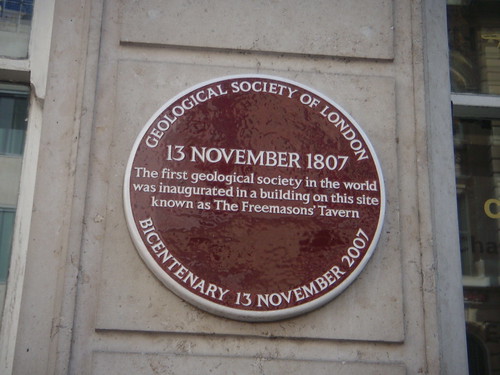
What is climate change, and how do geologists know about it?
What are the grounds for concern?
When and how did today’s climate become established?
What drives climate change?
What is the Greenhouse Effect?
What effect do natural cycles of climate change have on the planet?
Has sudden climate change occurred before?
Are there more recent examples of rapid climate change?
How did levels of CO2 in the atmosphere change during the ice age?
How has carbon dioxide (CO2) in the atmosphere changed over the longer term?
How has carbon dioxide in the atmosphere changed in recent times?
When was CO2 last at today’s level, and what was the world like then?
When global temperature changed, did the same change in temperature happen everywhere?
and, finally,
In conclusion - what does the geological record tell us about the potential effect of continued emissions of CO2?
The answer:
"it is reasonable to conclude that emitting further large amounts of CO2 into the atmosphere over time is likely to be unwise, uncomfortable though that fact may be."
Saturday, 23 October 2010
Climate hawks

there are plenty of people who understand climate change and support clean energy but do not share the rest of the ideological and sociocultural commitments that define environmentalism as historically understood in the U.S.
He's come up with another term: "climate hawks".
See seven pages of comments that follow.
[Crosspost.] Click here to read the rest of this post.
Monday, 18 October 2010
Action-packed day of blogging about water
Friday’s Blog Action Day – where the subject was water – had 5656 blogs from 143 countries reaching 40 million readers. This blog contributed with:
Surfing 4,623 blogs on water
Treadle pumps bring water to nearly 4m people
4,482 bloggers writing on one topic: water
For last year's Blog Action Day on climate change, Svati Bhogle, from TIDE, a 2008 Ashden Award winner, wrote about "the efficient use of energy, as different from abuse in the developed world and misuse in the developing world."
Monday, 4 October 2010
New website reports on how the arts in the UK are going green
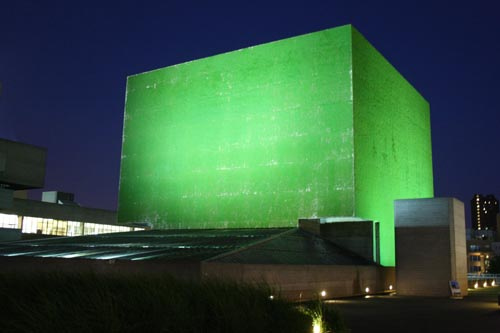 The website Sustainable Ability is a new arts project that aims:
to help drive forward transformative responses to resource scarcity and climate change from individuals and organisations working in the arts.
It is intended as another point of connection in the growing network of support designed to help the UK’s cultural and creative sector.
Sustainable Ability has just launched a report by Hilary Jennings and Lucy Neal on the cultural sector's response to climate change, along with a Google map of activities, the findings of a survey, and a useful list of additional resources.
For organisations and websites in the UK working in this field, see also: Julie's Bicycle, Tipping Point, Cape Farewell, Arcola, Do The Green Thing and - closer to home - Ashdenizen. See also what the National Theatre is doing to reduce its energy consumption.
Arts institutions should note that the Ashden Awards 2011 welcomes applications from the public sector: from fire stations, hospitals and colleges to theatres, galleries and museums.
Pic: Lyttelton Flytower by Ackroyd and Harvey
Update: Science foundation provides $700,000 to theatre company for climate change play Click here to read the rest of this post.
Wednesday, 29 September 2010
Cookstoves: "secret weapon against poverty and climate change"
Anne Wheldon, Senior Advisor for the Ashden Awards, will be giving a talk in central London tomorrow evening: 'Stoking up a cookstove revolution: The secret weapon against poverty and climate change'.
The event will be held at: The Carpenters Arms Pub, 12 Seymour Place (Marylebone), London, W1H 7NA Time: 18.30-20.30 Admission is free. The event is hosted by HEDON's London RIG. More information.
See also on this blog:
Prospects Rise for Clean Cooking in Poor Places (New York Times)
Clinton unveils U.S. funds for clean cookstove push (Reuters)
Secretary of State Clinton announces global cookstove initiative (Nature)
Hillary Clinton, cookstoves and "The Girl Effect". Watch a short film about why girls hold the key to transforming the world (Salon)
How Hillary Clinton's clean stoves will help African women (Guardian)
For more on stoves: Stoking up a cookstove revolution (Ashden Awards)
See also: Global Alliance for Clean Cookstoves and Hillary Clinton calls clean cookstoves a "cross-cutting issue"
And for some Ashden award-winning stove projects, go to: TWP/AHDESA, GERES Cambodia and Aprovecho/SSM.
Blog Action Day announces 'water' as this year's topic

Blog Action Day brings together bloggers from around the world to post about the same issue on the same day "with the aim of sparking a global discussion and driving collective action".
Last year 13,606 bloggers from 156 countries joined in the conversation about climate change.
We'll be blogging news on October 15 about Ashden Awards winners, such as: IDEI, CRELUZ, Practical Action and AIDFI (currently nominated for World Challenge award).
From 2009: We've signed up, have you? and Svati Bhogle, from TIDE, a 2008 Ashden Award winner, writes on last year's Blog Action Day about "the efficient use of energy, use as different from abuse in the developed world and misuse in the developing world." Click here to read the rest of this post.
Monday, 14 December 2009

This year I celebrate 10 years as director of Marches Energy Agency, a charity that encourages communities to adopt low carbon lifestyles. We believe that acting locally can help shrink the global carbon footprint.
We support and sustain energy-saving practices in all sectors of the community – parish, schools, businesses and households through five radical carbon-cutting projects. We can only say ‘job done’ when all the cavities have been filled, when all the community leaders have been trained, when the whole community has been engaged in this process.
Our daily work involves getting microgeneration installations on community buildings, giving advice to small businesses on how to obtain energy-saving grants, talking to low income families about how to get free insulation and working with schools on climate change education.
This work has achieved massive energy savings in 10 communities in Staffordshire, Herefordshire & Shropshire. In just one year, through local renewable energy, energy efficiency and other measures we helped over 60,000 individuals including the insulation of 4,500 homes saving 16 million kWh of energy a year.
For MEA there will never be a ‘declaration of peace’ moment in the war against climate change. We cannot afford to be complacent. Every day I meet brilliant individuals and witness inspiring projects giving their all to fight climate change. But I also see complacency, tired excuses and indifference. So there is still much more to be done.
Over the next 10 years we will continue this work, Copenhagen or not, helping communities recognise that they can play a significant part in achieving a low carbon future.
Read more Voices on Copenhagen
The Marches Energy Agency in Shropshire runs five environmental projects working together to reduce the carbon footprint of local communities.
View the Ashden Awards video of Marches Energy Agency:
Tuesday, 8 December 2009
Waving to Copenhagen
Guest post by Anne Wheldon, Technical Director at the Ashden Awards.
On Saturday, I went to London with my husband to take part in ‘the Wave’ – the national demonstration to highlight the seriousness of climate change and the need to take action, before the Copenhagen COP meeting. I’m not a ‘Frequent Demonstrator’ but I just felt that it was so important to be there and be counted. And it seems that over 40,000 other people thought the same. The numbers meant that we were still a long way up Whitehall at 3pm, when ‘the Wave’ encircled the House of Commons, but we still waved our placards and blew our whistles.
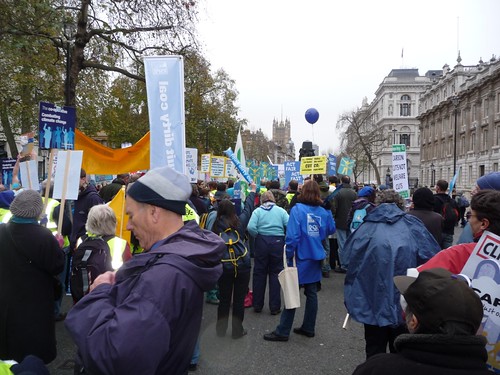
- There were people there of all ages, and representing such different interests. I don’t think there are many causes for which the Royal Society for the Protection of Birds, many faith groups, cyclists and the Socialist Workers Party would all march together.
- Although it was a cheerful event, there was also a strong sense of the absolute seriousness of the issue, with many people mentioning injustice – the injustice of how climate change is already having its most serious impacts on those least able to adapt, the injustice of our excesses leaving a damaged world for the future. There were serious conversations going on amidst the noise - it’s not often that complete strangers come up to you and start a discussion about green jobs.
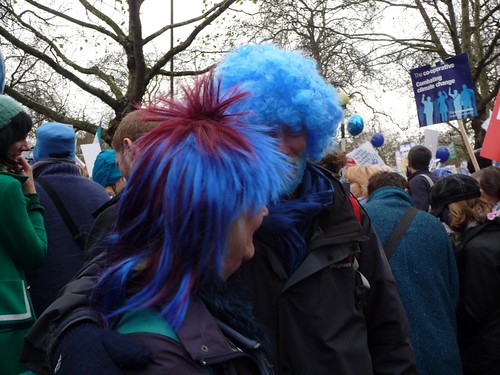
- It was a great idea to have a colour theme, with innovative uses of the colour blue in clothes, wigs, face paint, banners and placards. I’m quite tempted to suggest a colour theme for the next Ashden Awards annual conference….
Guest post by Anne Wheldon, Technical Director at the Ashden Awards. Click here to read the rest of this post.
Monday, 7 December 2009
Housing Retrofit is the biggest carbon saver

Housing emits 27% of the UK’s carbon emissions, providing a huge challenge for the year’s ahead. But the good news is that even owners of the five million older homes have the power to drastically reduce carbon. By retrofitting old houses with energy saving measures you can save between 60-80% of the property’s carbon footprint.
We’re calling on the government to help homeowners and social housing landlords by kick-starting a massive retrofit process. By providing low interest finance that makes repayment costs lower than fuel bill saving, the UK will move closer to meeting the goal of using 80% less carbon by 2050. German experience has shown that a euro spent by Government can stimulate up to six euros of energy improvements.
The Sustainable Energy Academy has set up the Old Home Superhome campaign, a network of more than 40 exemplar hard-to-treat homes across the UK that have reduced their energy use by at least 60 percent. We help ‘Superhome’ owners promote their achievements by opening their houses to the public during Open Days.
The Open Days have inspired thousands of visitors to take action in their own homes by seeing and experiencing the warmth and comfort of a low carbon home, and how easy it is to achieve.
“But how much does it cost?” everyone asks. About the same as you would spend on upgrading a kitchen or bathroom. Well worth it for the huge carbon savings you can make for yourself and for the planet.
Read more Voices on Copenhagen
The Sustainable Energy Academy (SEA) is spearheading the Old Home SuperHome scheme to transform the existing housing stock in the UK, with the ultimate aim of reducing domestic carbon emissions by 60%.
View the Ashden Awards video of SEA:
Developing countries need appropriate, low-cost technologies

The gravity and magnitude of climate change demands that we get down to quick, firm and sustainable action. I believe our environmental problems are of our own making and if we want to change what lies ahead we need to look at the actions of today.
IDEI is addressing the needs of poor farmers in India by promoting appropriate technologies and by optimising the use of water for irrigation. We have developed a simple treadle pump and drip irrigation technology for small hold farmers that are low cost and environment friendly. Together the two technologies have led to saving over 530 million litres of diesel, over 3000 million cubic meters of water and 417 million kWh of electricity,
Over one million farmers have adopted our technologies – that is around five million people - and made a net income of $1 billion.
We are fixing what exists. As the World Economic Forum highlighted recently, drip irrigation is improving irrigation systems, with reduced wastage of water through evaporation. Now we are advocating for greater accountability by questioning “subsidies” that are leading to the exploitation of our precious water resource.
IDEI does not believe in charity: we strategically leverage grants from donors to create markets for technologies - thus bringing down the overall cost for the farmer. By linking farmers and others in the supply chain to credit and by using Bollywood films to market the technologies we have made sure that they reach poor farmers throughout India, with interest growing in other parts of Asia and Africa.
Read more Voices on Copenhagen
International Development Enterprises India (IDEI) has developed extensive local supply chains to manufacture, distribute, sell and install the treadle pump, branded ‘Farmer’s Friend’
View the Ashden Awards videos of IDEI:
Ashden Award winners are pathfinders to a more sustainable future

Sustainable energy sources which reduce carbon, bring health and education opportunities and a better life to millions worldwide are not some distant dream – they are being used today by over one hundred Ashden Award-winning programmes.
Thousands of miles from Copenhagen, in countries like India, China, Tanzania and Brazil, there are outstanding enterprises delivering affordable and appropriate renewable energy technologies at a local level but on a large scale.
Renewable energy is transforming the lives of people in the developing world: women cooking on safe and efficient smoke-free stoves; children studying with solar lamps and farmers trebling their incomes by using simple treadle pumps to irrigate their crops. A study we commissioned in 2008 found that over 10 million peoples’ lives are being improved thanks to the work of just ten Ashden Award winners.
In the UK, Ashden Award winners are using renewable energy technologies, energy efficiency schemes and decentralised, low carbon sources of heat to create jobs, boost businesses and reduce fuel poverty while at the same time substantially reducing carbon emissions.
However, all these technologies need the political and financial will to scale-up and reach many more millions of people. Now is the time to back these and similar pathfinders to a sustainable future and generate huge social, economic and environmental benefits.
Read more Voices on Copenhagen
The Ashden Awards champion practical, local energy solutions that cut carbon, protect the environment, reduce poverty and improve people’s lives.
Friday, 13 November 2009
The real agenda for Copenhagen is tackling poverty

Poverty is the greatest threat to our environment. The poor use some of the most inefficient technologies and polluting fuels - not because they are cheap but because they don’t have a choice.
Today’s debate on the climate change treaty is seen as between the developed world and the developing world. It has led the rich in developing countries to hide behind the poor and the poor in developing countries to be short changed. The reality is we all have a vested interested in getting this treaty right – rich and poor.
We have before us a wonderful and unique opportunity – to implement climate change solutions that will also reduce poverty, like affordable solar energy systems. My social enterprise, Selco India has provided 112,000 solar home systems to low income households and institutions. We ensure that the systems are affordable by partnering with microfinance organisations that provide small loans. We have also set up a pilot fund to guarantee the deposits on solar systems for very poor families. Nothing can compare with the thrill of someone switching on a light for the first time and knowing how this can change their life!
Much, much more of this can be done and we are showing just what's possible. If we partner with the poor to create options for them to produce their energy sustainably – be it through renewable energies or clean stoves or biogas – we will get a double whammy: a curb on climate change but also a route for them out of the relentless poverty trap.
We must put poverty at the centre stage of Copenhagen and not focus on the false confrontation between developing versus developed world. When the discussion finally turns towards providing sustainable energy solutions for the poor a new dawn of social justice and economic progress will begin.
Read more Voices on Copenhagen
Selco Solar Light designs and sells solar home systems, primarily to meet the needs of the poor. The company was winner of the Outstanding Achievement Award from the Ashden Awards for Sustainable Energy in 2007 and a 2005 winner.
View the Ashden Awards video of SELCO:
