
 Sir David Attenborough answers questions from readers in today's Observer. He says he's against waste, he's an ardent recycler, he has low-energy lightbulbs, he wears a pullover rather than turning on the electric heater, and he's installing solar panels. His reply to one question sums up his philosophy.
Q: I work in a secondary school. What one thing would you most like us to impress upon young people's minds? Sylvia Greaves, learning mentor in a secondary school, Huddersfield
A: That we are part of the animal world. We are part of the natural world.
Watch Sir David Attenborough at this year's Ashden Awards.
Sunday, 31 October 2010
The world according to David Attenborough


Friday, 29 October 2010
Mike set to save £500-£600 on gas and electricity
The story so far: three years ago Mike Pepler, our UK Awards Manager, and his wife Tracy, bought an eight-acre wood. This year they bought a house. Now they are heating the house with the logs from the wood.
Since this is the last day of Energy Saving Week we've asked Mike to update us on progress, now he's been in his new house a few weeks. It's going so well, he reckons this year he'll save more than £500 on gas and electricity bills.
Mike writes:
We’ve had our woodburner and solar thermal installation running for a month now, and the loft insulation has been complete for a few weeks as well, so how’s it going?
The good news is that the house certainly isn’t cold. After a bit of experimentation we’ve figured out how to set the stove to burn slowly overnight when it’s cold, and then in the morning there’s a few embers glowing so it can be quickly got back up to full heat if it’s needed.
We’ve found that as the house faces almost south, there’s a lot of solar gain on sunny days, reducing the need to light the woodburner, even on relatively cold days.
The solar thermal is working well, getting the tank up to 70C on sunny days, and pre-heating the water at the bottom of the tank to 30C even on somewhat cloudy days. Combined with the heat input from the stove, there’s been no shortage of hot water.
We’re pleased with the way the heat from the stove is circulating through the house, both by convection and using the radiators. Although the main thermosyphon (or gravity) loop is to the hot water cylinder and bathroom radiator, quite a bit of heat can also thermosyphon to the radiators, which are all controlled by thermostatic valves. This has meant that we haven’t needed to turn on the central heating pump.
Now that we’re only using gas for the hob on the cooker, daily usage has dropped to under 1kWh, which should lead to an annual bill of £25 at most.
When it comes to electricity, the main guzzlers in the house are the fridge and freezer, although both are A+ rated. We chose a “larder fridge” (i.e. no ice box), as this improves efficiency a lot, and our freezer is a slimline version that opens on the top, as this is much more efficient than having a door on the front, which lets the cold air spill out every time you open it. All our lighting is low-energy CFL bulbs, and our computers are energy-efficient laptops. Oh, and we don’t have a TV, though we do use the BBC iPlayer. The upshot of all this is that our electricity usage so far has been a bit over 3kWh a day, so annual usage will hopefully be between 1200 and 1500 kWh, resulting in an annual bill of around £200.
Overall, if our gas and electricity costs come in at a bit over £200, this will be significantly less than the average of perhaps £7-800 for a household like ours.
Of course, we still need to get the wood for our woodburner, and although we’re not buying that, we do have to work hard to get to it, but at least that’s something we enjoy. We’re currently cutting wood for use in two year’s time, after it’s properly seasoned. It’ll be great to see the trees we’re coppicing now growing back next year as well.
Thursday, 28 October 2010
Top energy scientists answer 'toughest' questions
The Guardian has invited readers to post questions on peak oil, wind power, nuclear power and other subjects for a panel of six of the world's leading energy scientists. Readers questions - so far - are here. One of the questions in the list is really two questions, and the second half of the question is a tough one:
Do you think storage is the solution to managing the energy balance and if so what type of energy storage mechanism will dominate the future landscape of the electricity networks?
Is there a tougher one?
Wednesday, 27 October 2010
How to turn a small, cold, dark house into a SuperHome
 As part of Energy Saving Week, Juliet Heller, the Ashden Awards Media and PR Manager, writes about moving to Essex and converting an Edwardian terraced house that had felt "small, cold and dark" into an officially-accredited SuperHome. The aim was to show how green an old house could be.
In this post, Juliet explains the range of issues addressed and the measures taken: from solar thermal gain, efficient wood burning stove, solar hot water and insulation to secondary heating and water use.
The post also explains what a SuperHome is, the benefits of a low-carbon home, and what more there still is to do.
The story so far
After many years in London, Ian Daglish and Juliet Heller, with their young son Callum, decided to go rural and adopt a low carbon lifestyle. In 2003 they moved into Tollesbury, a village on the Blackwater estuary in Essex. This vibrant working community which has a population of around 3,000 people has a history steeped in fishing and farming. Juliet writes:
At the heart of our relocation was a dream to buy a period house where we could implement sustainable design and technology on a low budget. A few years later we found the ideal property: a small terraced dwelling, exactly 100 years old, situated on a quiet, rural lane on the village edge, surrounded by fields and farm land.
The eco scheme
The house met our main criteria: it required a complete refurbishment and it had a South facing aspect.
Typically Edwardian, the main house has a square footprint with a two storey rear addition. The ground floor was divided into a living room, dining room and kitchen with a 60s extension at the rear to house a bathroom and toilet. It felt small, cold and dark, but that was soon to change dramatically.
 The refurbishment project was managed by Ian, who's an experienced building contractor with an engineering background and longstanding interest in sustainability. Ian’s aim was to contradict a prevailing belief that older properties could not be “green” and demonstrate that they could be made super energy efficient - at an affordable price.
The scheme for the house involved re-designing the ground floor to make it completely open plan, and installing extensive glazing on the rear, to bring more light and warm sun into the house. It also included a loft conversion to accommodate a guest room and office.
The house was planned and equipped to be as energy efficient as possible, using insulation, renewable energy and smart environmental design. Within four months the refurbishment was complete and the three of us moved into an attractive, light and spacious new home.
Creating a ‘SuperHome’
We undertook a range of measures to reduce the carbon impact of the house:
Solar thermal gain: passive solar gain occurs when a house benefits from the internal heat generated by the low sun during winter months. The open plan design and installation of glazing on the South facing elevation heat the house through the natural power of the sun, at zero cost.
Efficient wood burning stove: the wood burning stove is integral to the scheme. The original chimney breast was widened to allow for a 10 kilowatt convection stove. With the open plan design, its heat radiates and warms the whole house, and the temperature can be regulated by opening or closing bedroom doors. Only seasoned, locally-sourced hardwoods are used.
Solar hot water: solar panels on the kitchen roof are South-facing and during April to October they provide at least 90% of the household’s hot water.
Insulation: insulation was installed during the loft conversion thus removing a large cold area within the house. Unusually for a property of its age, the house had cavity walls. Once this had been established, all four houses in the terrace were able to benefit from cavity wall insulation.
Electricity consumption: all domestic appliances are A-rated for energy efficiency and clothes are dried outside. The majority of the lights throughout the house are low energy, and less efficient overhead halogen lights are used as little as possible. We track the energy consumption with an OWL energy monitor, switching off lights and appliances when they are not needed.
Secondary heating: an oil condensing boiler (there is no gas in the village) was fitted for back up heating and hot water but is not required during summer months. At colder times of year the wood stove, passive solar gain and solar water heating heat the house and water.
Water: as 30% of domestic water consumption goes down the pan, a dual flush toilet was a must. The family opts for showers instead of baths as they consume a fraction of water. An unforeseen benefit was a sealed well in the back garden previously used to supply the terrace for domestic needs and is now used to water the plants.
What are the benefits of a low carbon home?
 The house is warm and comfortable to live in, as well as bright and airy thanks to the building design and the harnessing of the natural heat of the sun. It also requires very little electricity, water and fuel, as the yearly bills confirm. With such low electricity and water use, the utility companies were initially regularly in contact to check whether the meters were accurate!
The combination of the wood burner acting as the household’s primary heat source, and the use of solar hot water, annual heating bills have been slashed by more than 75% compared with an equivalent house.
More to do
Next year we hope to install high-efficiency sash windows and a new sealed front door to further draught-proof the house.
Another aim is to replace all overhead halogen lighting in the living area and loft with efficient LED lights.
What is a “SuperHome”?
Having reduced its CO2 emissions by 62%, in 2009, the house achieved SuperHome status from the Sustainable Energy Academy and National Energy Foundation who together run the Old Home SuperHome Project, an alliance of exemplar low carbon homes across the UK.
Each SuperHome has been assessed for a range of energy efficiency criteria and found to have reduced its carbon footprint by over 60% compared to an equivalent home of its age and size. SuperHome owners hold regular open home days to encourage other home owners to take energy saving steps, helping the UK move towards its target to cut carbon emissions by 34% by 2020.
About us
Ian Daglish is a building consultant specialising in sustainable building refurbishments, with over 20 years’ experience as a building contractor. He has studied for an MSc in sustainable building from the Centre for Alternative Technology, the world’s leading centre for pioneering sustainable technologies.
The eco scheme
The house met our main criteria: it required a complete refurbishment and it had a South facing aspect.
Typically Edwardian, the main house has a square footprint with a two storey rear addition. The ground floor was divided into a living room, dining room and kitchen with a 60s extension at the rear to house a bathroom and toilet. It felt small, cold and dark, but that was soon to change dramatically.
 The refurbishment project was managed by Ian, who's an experienced building contractor with an engineering background and longstanding interest in sustainability. Ian’s aim was to contradict a prevailing belief that older properties could not be “green” and demonstrate that they could be made super energy efficient - at an affordable price.
The scheme for the house involved re-designing the ground floor to make it completely open plan, and installing extensive glazing on the rear, to bring more light and warm sun into the house. It also included a loft conversion to accommodate a guest room and office.
The house was planned and equipped to be as energy efficient as possible, using insulation, renewable energy and smart environmental design. Within four months the refurbishment was complete and the three of us moved into an attractive, light and spacious new home.
Creating a ‘SuperHome’
We undertook a range of measures to reduce the carbon impact of the house:
Solar thermal gain: passive solar gain occurs when a house benefits from the internal heat generated by the low sun during winter months. The open plan design and installation of glazing on the South facing elevation heat the house through the natural power of the sun, at zero cost.
Efficient wood burning stove: the wood burning stove is integral to the scheme. The original chimney breast was widened to allow for a 10 kilowatt convection stove. With the open plan design, its heat radiates and warms the whole house, and the temperature can be regulated by opening or closing bedroom doors. Only seasoned, locally-sourced hardwoods are used.
Solar hot water: solar panels on the kitchen roof are South-facing and during April to October they provide at least 90% of the household’s hot water.
Insulation: insulation was installed during the loft conversion thus removing a large cold area within the house. Unusually for a property of its age, the house had cavity walls. Once this had been established, all four houses in the terrace were able to benefit from cavity wall insulation.
Electricity consumption: all domestic appliances are A-rated for energy efficiency and clothes are dried outside. The majority of the lights throughout the house are low energy, and less efficient overhead halogen lights are used as little as possible. We track the energy consumption with an OWL energy monitor, switching off lights and appliances when they are not needed.
Secondary heating: an oil condensing boiler (there is no gas in the village) was fitted for back up heating and hot water but is not required during summer months. At colder times of year the wood stove, passive solar gain and solar water heating heat the house and water.
Water: as 30% of domestic water consumption goes down the pan, a dual flush toilet was a must. The family opts for showers instead of baths as they consume a fraction of water. An unforeseen benefit was a sealed well in the back garden previously used to supply the terrace for domestic needs and is now used to water the plants.
What are the benefits of a low carbon home?
 The house is warm and comfortable to live in, as well as bright and airy thanks to the building design and the harnessing of the natural heat of the sun. It also requires very little electricity, water and fuel, as the yearly bills confirm. With such low electricity and water use, the utility companies were initially regularly in contact to check whether the meters were accurate!
The combination of the wood burner acting as the household’s primary heat source, and the use of solar hot water, annual heating bills have been slashed by more than 75% compared with an equivalent house.
More to do
Next year we hope to install high-efficiency sash windows and a new sealed front door to further draught-proof the house.
Another aim is to replace all overhead halogen lighting in the living area and loft with efficient LED lights.
What is a “SuperHome”?
Having reduced its CO2 emissions by 62%, in 2009, the house achieved SuperHome status from the Sustainable Energy Academy and National Energy Foundation who together run the Old Home SuperHome Project, an alliance of exemplar low carbon homes across the UK.
Each SuperHome has been assessed for a range of energy efficiency criteria and found to have reduced its carbon footprint by over 60% compared to an equivalent home of its age and size. SuperHome owners hold regular open home days to encourage other home owners to take energy saving steps, helping the UK move towards its target to cut carbon emissions by 34% by 2020.
About us
Ian Daglish is a building consultant specialising in sustainable building refurbishments, with over 20 years’ experience as a building contractor. He has studied for an MSc in sustainable building from the Centre for Alternative Technology, the world’s leading centre for pioneering sustainable technologies.
Juliet Heller is a writer and communications consultant specialising in the environment and sustainable energy. See www.julietheller.co.uk. To arrange a visit or discuss ideas, email Juliet@julietheller.co.uk
When electricity boards went on the offensive

This week is Energy Saving Week, so it's maybe appropriate that BBC4 has launched a three-part series, which shows how it is we came to use the amount of electricity we do.
The Secret Life of the National Grid is a three-part series that charts the development of Britain's national electricity grid and "how it sparked modern Britain into being - transforming our landscape, our politics and our lives".
Last night's programme showed how the Grid was established. Next week's programme shows how, once the Grid was established, great efforts were made to encourage people to use as much electricity as possible.
So electricity boards went on the offensive and actively promoted electrical appliances - particularly high current ones such as cookers and immersion heaters. Electricity showrooms became a fixture on high streets to entice the British to use electricity in their homes.
The series continues on 2nd and 9th November. (Pic: Greenpeace)
Read the Ashden Awards report Power to our neighbourhoods: towards integrated local sustainable energy solutions.
Tuesday, 26 October 2010
Gamesa invests €150 million in offshore wind in UK
Yesterday morning, the Prime Minister, David Cameron, said, "I want us to be a world leader in offshore wind energy."
A few hours later, the Spanish company, Gamesa, announced plans to base the worldwide centre of its offshore business in the UK, investing up to €150 million through 2014.
Gamesa will also create a wind turbine blade manufacturing plant, a turbine assembly plant and associated R&D centre, port logistics and operation and maintenance services at different locations across the UK.
The British Ambassador to Spain, Giles Paxman, blogs today that this is:
a terrific vote of confidence in the UK’s future leadership in wind energy.
Energy Saving Week: Ashden winners tackle energy-saving in businesses
It's Energy Saving Week, and we're highlighting how Ashden winners are saving energy. Yesterday we looked at community-based initiatives, today it's energy-saving in businesses.
Ashden winners have been helping businesses to save millions and cut carbon emissions. ENWORKS in the North West has worked with over 10,000 companies since 2002. By helping businesses to use its online resource efficiency toolkit, it can show how new installations, changes in manufacturing processes, or behaviour changes, can impact on carbon emissions and competitiveness. ENWORKS is currently helping businesses with annual cost savings of £117 million and savings of 855,000 tonnes of CO2 emissions per year.
Global Action Plan (GAP) encourages behaviour change within the workplace by enabling businesses to develop their own energy-savvy teams called ‘Environment Champions’. Usually, around 20 staff work with GAP to understand where and how energy is used within the company, before creating a plan for tackling it.
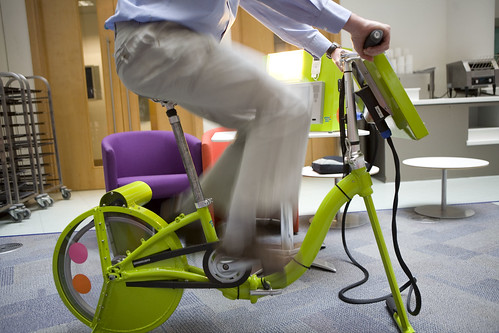
We especially like the energy bike which GAP loans to companies for awareness-raising events (pic). You get to feel - through the burn in your thighs - just how much energy it takes to light a bulb, run a laptop or play an ipod. GAP has worked with over 70 companies and trained 1,200 people, influencing 86,000 staff and saving around 9,300 CO2 tonnes a year.
You can find out about the energy saving work of all of our Award winners from our website. Tomorrow we'll be hearing from members of the Ashden team who are saving energy by refurbishing their homes.
More on Energy Saving Week
Obama says energy efficiency will get US "quarter of the way"
Ashden winners tackle energy saving in the community
This week is Energy Saving Week
Three simple energy-saving steps could save £2 billion
The latest research for the Energy Saving Trust claims that UK householders could save more than £2 billion every year by taking three simple energy-saving steps.
The report says that if every UK householder that was able to went and insulated their cavity walls and lofts up to 270mm, replaced old fashioned bulbs with compact fluorescent light bulbs (CFLs) and turned their appliances off standby, owners would not only save hundreds of pounds a year on their fuel bills but also cut nearly 10 million tonnes of CO2, equivalent to taking almost 3.5 million cars off UK roads.
More on Energy Saving Week
Obama says energy efficiency will get US "quarter of the way"
Winners tackle energy saving in the community
This week is Energy Saving Week
Hat-tip: Edie.
Obama says energy efficiency will get US "quarter of the way there"
 This week is Energy Efficiency Week. In this interview with National Journal, President Obama argues that whatever you think about climate change, energy efficiency still makes sense.
So my approach to Republicans would be to say, "Regardless of what you think about climate change, here are a bunch of things that are smart to do. It will save consumers money, it will save the country as much money going into foreign oil imports, so let’s concentrate on things that we just know are smart to do." If we do that, we can probably get a quarter of the way there in terms of where we need to be in terms of carbon emissions.
(Hat-tip: DotEarth)
Click here to read the rest of this post.
South Africa plans biggest solar plant in world
South Africa unveils plans for world's biggest solar power plant. Giant mirrors and solar panels in Northern Cape would reduce carbon emissions and generate one-tenth of the country's energy needs. The government says the Northern Cape province is among the sunniest 3 percent of regions in the world with minimal cloud or rain.
Click here to read the rest of this post.Monday, 25 October 2010
Energy Saving Week: how Ashden winners tackle energy saving in communities
This week is Energy Saving Week, so it's a good time to ask the question: how do you stimulate change across communities and businesses to make real reductions in energy use?
Ashden winners have been grappling with this issue and producing innovative results. Take the 2010 winner Isle of Eigg Heritage Trust, an impressive example of community-led change. The Trust was bought out by the community in 1997, and its efforts have led to a staggering 47% reduction in energy use.
They’ve achieved this by producing about 90% of their own electricity through renewables, offering incentives to install insulation and other energy-saving measures in the home, and, crucially, getting the community to monitor and keep their energy use below 5kW in homes and 10kW in businesses.
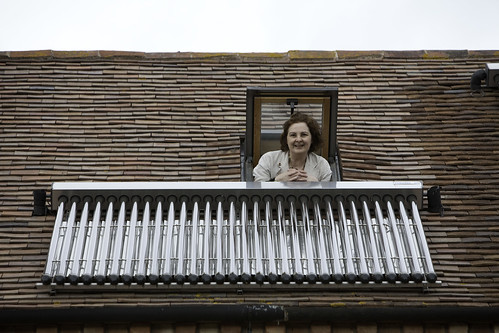
Communities also play a big role in the work of 2009 winner Marches Energy Agency (pic). They followed the Low Carbon Communities programme which helps communities to understand the issues (through fairs and presentations), and then to pursue, with access to grants and technical assistance, clear carbon-reduction targets. This has led to 1,400 technical installations in homes, businesses and community buildings across six local areas saving around 1,715 tonnes of CO2 (about 5% of the overall community use).
Tomorrow we profile two Ashden winners who work to reduce the energy use of businesses. Over the rest of this week, we’ll be writing more about the experiences of members of the Ashden awards team who are retrofitting their homes.
See also: A trip to the Isle of Eigg
Tomorrow we profile two Ashden winners who work to reduce the energy use of businesses. Over the rest of this week, we’ll be writing more about the experiences of members of the Ashden awards team who are retrofitting their homes.
See also: A trip to the Isle of Eigg
Sunday, 24 October 2010
100 objects in 5 minutes with solar lantern at 4 mins 50 secs
 This blog has probably run more posts than any other blog on the 100th object in A History of The World. But then, these 100 objects stretch back from the Olduvai stone chopping tool, made two million years ago, to the solar-powered lantern, made this year, and illustrated by an Ashden Award winner.
For those who missed the series, you can watch the five-minute version here, with the solar lantern coming in seconds before the end.
If you have more than five minutes, you can read our other posts here:
Nick Stern says solar power can free communities from corrupt practices,
In one hour from the sun, we get enough energy for a year,
100th Object introduces us to “the noise of the day",
100th object reminds us of extraordinary amount the semiconductor transistor has done for 21st century life
100th Object going "to change the way we think",
After today's 99th Object, one more to go,
From 100th Object to 100s of solar projects,
What the Twitterverse thinks of 100th Object,
100th Object: "a story worthy of this generation",
Solar-powered lamp revealed as 100th Object,
Tomorrow’s vote on 100th Object keeps solar in the news,
Solar lamp an icon in social entrepreneurship
and
Will solar powered lamp be 100th Object?
This week is "Energy Saving Week"

This week is Energy Saving Week. At the Energy Saving Trust - which helps people be more energy efficient in their homes and save money on their energy bills - they are going to concentrate on one area of energy efficiency each day:
Monday 25th Launch day
Tuesday 26th Insulation
Wednesday 27th Generate your own energy
Thursday 28th Energy saving products
Friday 29th Transport
This blog will also be hearing about energy efficiency from members of the Ashden Awards team. There will be reports and photographs from both Mike's eco-refurbishment of his new home and Juliet's success in turning her Edwardian terraced house in Essex, which had "felt small, cold and dark", into a SuperHome. We'll also hear about Sarah's visit over the weekend to another SuperHome, this one belonging to John Doggart, chairman of the Sustainable Energy Academy, an Ashden Award winner in 2009.
Saturday, 23 October 2010
Climate hawks

there are plenty of people who understand climate change and support clean energy but do not share the rest of the ideological and sociocultural commitments that define environmentalism as historically understood in the U.S.
He's come up with another term: "climate hawks".
See seven pages of comments that follow.
[Crosspost.] Click here to read the rest of this post.
Friday, 22 October 2010
Nick Stern says solar power can free communities from corrupt practices
 Carla Jones, from the Ashden Awards communications team, writes about this morning's 100th Object
I’ve been aware of the impressive health and economic benefits of off-grid solar lamps. But what struck me this morning from Lord Stern’s comments was the idea that solar energy can bring political empowerment.
As well as being a more practical solution for the world’s rural communities, off-grid and local energy can also free people from the possibility of corruption.
Lord Stern (pictured) told Neil MacGregor:
“One of the great things about solar power is freedom from the grid. In many parts of the world, particularly the developing world, particularly South Asia and Africa, it is extremely unreliable.
“One of the great things about solar power is freedom from the grid. In many parts of the world, particularly the developing world, particularly South Asia and Africa, it is extremely unreliable.
Also the energy is unreliable from the point of view of interventions from corrupt people – it’s all too easy to flick a switch and turn off your energy supply and then demand payment to put it back on.
With solar power you can organise it yourself, you’re in control. So it’s really empowering relative to relying on the grid system”
It's one more way that solar energy allows people within rural communities to take control over their own lives.
Click here to read the rest of this post.
It's one more way that solar energy allows people within rural communities to take control over their own lives.
In one hour from the sun, we get enough energy for a year
Nicholas Stern, author of the Stern Review, explains to Neil MacGregor the potential of the solar panel and why we are on the verge of a new industrial revolution.
"One of the great advantages of solar energy is that as far as we humans are concerned, it's almost limitless. Why? Because in one hour we get as much energy from the sun on the earth as we use right across the planet in one year. And further, the cost of accessing that limitless supply of energy is really crashing down. Just in the last couple of years, the cost of a solar panel has fallen by about half."
100th Object introduces us to "the noise of a new day"
 Sarah Butler-Sloss, founder director of the Ashden Awards, says this morning's broadcast about the 100th Object brought a fresh perspective to how we think about solar energy.
Today's programme rightly stressed the importance and benefits that solar energy can bring to the 1.6 million people without access to electricity, in terms of improvements to health, education and livelihoods. It also made clear the freedom and independence that this technology brings.
But what the programme brought us, most of all, was a really fresh and exciting perspective. It was very powerful to hear Nicholas Stern say that we are at the start of a new industrial revolution. It was also fascinating to hear how myths from around the world show how humans have always dreamt of storing energy from the sun.
And it was very moving, after having been reminded how much solar energy could achieve today, to hear the recording of the sun, and to have it described as "the noise of a new day". Let's hope that it is.
100th object reminds us of extraordinary amount the semiconductor transistor has done for 21st century life
 Anne Wheldon, Senior Advisor for the Ashden Awards, writes
Neil MacGregor couldn’t have made a better choice for his 100th object than the solar panel with lamp and charger, not just for what it does, but for what it stands for.
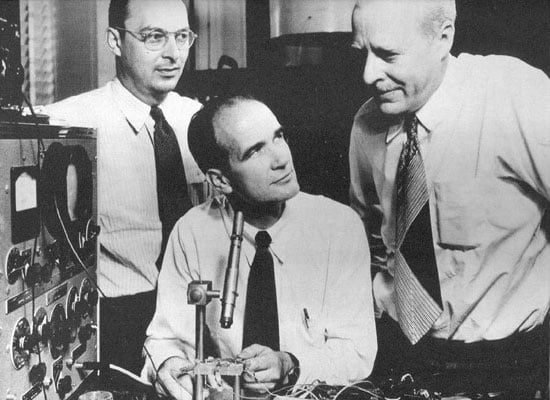
The solar cell is the younger sister of the semiconductor transistor, the key invention that started the semiconductor industry. For me, the solar panel stands for all the science and technology which has gone into the semiconductor industry, providing the computers, mobile phones, communications and entertainment that are 21st century life.
Already solar cells are powering crucial parts of the semiconductor world, from communications satellites to lamps and chargers. And now there are real signs that solar will move from niche to bulk power supply.
pic: John Bardeen, William Shockley and Walter Brattain won the Nobel Prize in Physics in 1956 for their invention of the semiconductor transistor.
See also 100th Object going "to change the way we think", After today's 99th object, one more to go, From 100th Object to 100s of solar projects, What the Twitterverse thinks of 100th Object, 100th Object: "a story worthy of this generation", Solar-powered lamp revealed as 100th Object, Tomorrow’s vote on 100th object keeps solar in the news, Solar lamp an icon in social entrepreneurship and Will solar powered lamp be 100th object?
100th object going "to change the way we think"
 In an hour's time, the British Museum director Neil MacGregor will give the last of his 100 talks in A History of the World. The 100th object is the solar-powered lantern.
A History of the World, or AHOW, has not focussed on the history of conflict, or the clash of personalities, but on the history of things, how things influence one another, and how those things have changed the way we live. It's global, generous, and disarming.
The statistics bear this out. Half of the 10 million downloads have been from outside the UK.
At the very start we learnt about the Olduvai stone-chopping tool (picture) the oldest humanly-made object in the British Museum. The choice of the solar-powered lantern is entirely consistent with that early choice. Last week, Neil MacGregor said the idea of capturing the sun is:
"the oldest myth of every culture in the world. You can take the sun and use it whenever you want. The myths in Ancient Egypt, and every culture, are now reality ... We felt that this was a kind of tool that – like the stone chopping tool – is really going to change lives, to change the way we think and the way we are."
Thursday, 21 October 2010
After today's 99th object, one more to go
The 96th object in A History of the World in a 100 Objects was a Russian Revolutionary plate. The 97th object was a David Hockney print showing two men in bed. The 98th object was the Throne of Weapons made out of guns. The 99th object was a credit card.
Tomorrow at 9.45am, and then again at 7.45pm, the British Museum's director Neil MacGregor will discuss the 100th object, the solar-powered lantern, and the future of renewable, non-polluting energy that has the potential to liberate the developing world.
On this blog tomorrow, we will have comments about the broadcast from Ashden Awards' founder director, Sarah Butler-Sloss, senior adviser Anne Wheldon, and other members of the Ashden team. We'll also round-up what others are saying on blogs and tweets about the 100th Object.
See also From 100th Object to 100s of solar projects, What the Twitterverse thinks of 100th Object, 100th Object: "a story worthy of this generation", Solar-powered lamp revealed as 100th Object, Tomorrow’s vote on 100th object keeps solar in the news, Solar lamp an icon in social entrepreneurship and Will solar powered lamp be 100th object?
Subscribe to:
Posts (Atom)
