
Last week we blogged that Fatih Birol, chief economist at the International Energy Agency, had said the unsayable: that is, it's virtually impossible for us to meet climate change targets with current policies.
Dr Birol made these remarks at a lecture at the Grantham Institute for Climate Change. The slides from that lecture are now online. The concluding slide states:
Recently announced policies can make a difference, but fall well short of what is needed for a secure & sustainable energy future
The age of cheap oil is over, though policy action could bring lower international prices than would otherwise be the case
Stronger penetration of natural gas can have profound implications for energy markets and environment
Renewables are entering the mainstream, but long-term support is needed to boost their competitiveness
Lack of ambition in Copenhagen/Cancun has increased the cost of achieving the 2C goal & made it less likely to happen
Thursday, 27 January 2011
If you missed IEA's chief economist "saying the unsayable", slides from the talk are now online


Monday, 14 December 2009
 Richard Davies, Director of the Marches Energy Agency.
This year I celebrate 10 years as director of Marches Energy Agency, a charity that encourages communities to adopt low carbon lifestyles. We believe that acting locally can help shrink the global carbon footprint.
We support and sustain energy-saving practices in all sectors of the community – parish, schools, businesses and households through five radical carbon-cutting projects. We can only say ‘job done’ when all the cavities have been filled, when all the community leaders have been trained, when the whole community has been engaged in this process.
Our daily work involves getting microgeneration installations on community buildings, giving advice to small businesses on how to obtain energy-saving grants, talking to low income families about how to get free insulation and working with schools on climate change education.
This work has achieved massive energy savings in 10 communities in Staffordshire, Herefordshire & Shropshire. In just one year, through local renewable energy, energy efficiency and other measures we helped over 60,000 individuals including the insulation of 4,500 homes saving 16 million kWh of energy a year.
For MEA there will never be a ‘declaration of peace’ moment in the war against climate change. We cannot afford to be complacent. Every day I meet brilliant individuals and witness inspiring projects giving their all to fight climate change. But I also see complacency, tired excuses and indifference. So there is still much more to be done.
Over the next 10 years we will continue this work, Copenhagen or not, helping communities recognise that they can play a significant part in achieving a low carbon future.
Read more Voices on Copenhagen
The Marches Energy Agency in Shropshire runs five environmental projects working together to reduce the carbon footprint of local communities.
View the Ashden Awards video of Marches Energy Agency:
Tuesday, 8 December 2009
Waving to Copenhagen
Guest post by Anne Wheldon, Technical Director at the Ashden Awards.
On Saturday, I went to London with my husband to take part in ‘the Wave’ – the national demonstration to highlight the seriousness of climate change and the need to take action, before the Copenhagen COP meeting. I’m not a ‘Frequent Demonstrator’ but I just felt that it was so important to be there and be counted. And it seems that over 40,000 other people thought the same. The numbers meant that we were still a long way up Whitehall at 3pm, when ‘the Wave’ encircled the House of Commons, but we still waved our placards and blew our whistles.
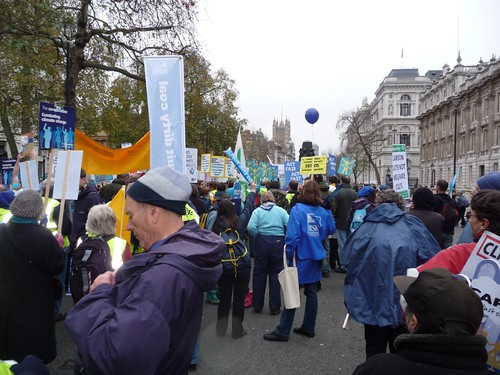
- There were people there of all ages, and representing such different interests. I don’t think there are many causes for which the Royal Society for the Protection of Birds, many faith groups, cyclists and the Socialist Workers Party would all march together.
- Although it was a cheerful event, there was also a strong sense of the absolute seriousness of the issue, with many people mentioning injustice – the injustice of how climate change is already having its most serious impacts on those least able to adapt, the injustice of our excesses leaving a damaged world for the future. There were serious conversations going on amidst the noise - it’s not often that complete strangers come up to you and start a discussion about green jobs.
- It was a great idea to have a colour theme, with innovative uses of the colour blue in clothes, wigs, face paint, banners and placards. I’m quite tempted to suggest a colour theme for the next Ashden Awards annual conference….

Guest post by Anne Wheldon, Technical Director at the Ashden Awards. Click here to read the rest of this post.
Monday, 7 December 2009
Housing Retrofit is the biggest carbon saver
 John Doggart, director of The Sustainable Energy Academy.
Housing emits 27% of the UK’s carbon emissions, providing a huge challenge for the year’s ahead. But the good news is that even owners of the five million older homes have the power to drastically reduce carbon. By retrofitting old houses with energy saving measures you can save between 60-80% of the property’s carbon footprint.
We’re calling on the government to help homeowners and social housing landlords by kick-starting a massive retrofit process. By providing low interest finance that makes repayment costs lower than fuel bill saving, the UK will move closer to meeting the goal of using 80% less carbon by 2050. German experience has shown that a euro spent by Government can stimulate up to six euros of energy improvements.
The Sustainable Energy Academy has set up the Old Home Superhome campaign, a network of more than 40 exemplar hard-to-treat homes across the UK that have reduced their energy use by at least 60 percent. We help ‘Superhome’ owners promote their achievements by opening their houses to the public during Open Days.
The Open Days have inspired thousands of visitors to take action in their own homes by seeing and experiencing the warmth and comfort of a low carbon home, and how easy it is to achieve.
“But how much does it cost?” everyone asks. About the same as you would spend on upgrading a kitchen or bathroom. Well worth it for the huge carbon savings you can make for yourself and for the planet.
Read more Voices on Copenhagen
The Sustainable Energy Academy (SEA) is spearheading the Old Home SuperHome scheme to transform the existing housing stock in the UK, with the ultimate aim of reducing domestic carbon emissions by 60%.
View the Ashden Awards video of SEA:
Developing countries need appropriate, low-cost technologies
 Amitabha Sadangi is Director of International Development Enterprises India (IDEI), winner of the Ashden Award’s Outstanding Achievement Award in 2009.
The gravity and magnitude of climate change demands that we get down to quick, firm and sustainable action. I believe our environmental problems are of our own making and if we want to change what lies ahead we need to look at the actions of today.
IDEI is addressing the needs of poor farmers in India by promoting appropriate technologies and by optimising the use of water for irrigation. We have developed a simple treadle pump and drip irrigation technology for small hold farmers that are low cost and environment friendly. Together the two technologies have led to saving over 530 million litres of diesel, over 3000 million cubic meters of water and 417 million kWh of electricity,
Over one million farmers have adopted our technologies – that is around five million people - and made a net income of $1 billion.
We are fixing what exists. As the World Economic Forum highlighted recently, drip irrigation is improving irrigation systems, with reduced wastage of water through evaporation. Now we are advocating for greater accountability by questioning “subsidies” that are leading to the exploitation of our precious water resource.
IDEI does not believe in charity: we strategically leverage grants from donors to create markets for technologies - thus bringing down the overall cost for the farmer. By linking farmers and others in the supply chain to credit and by using Bollywood films to market the technologies we have made sure that they reach poor farmers throughout India, with interest growing in other parts of Asia and Africa.
Read more Voices on Copenhagen
International Development Enterprises India (IDEI) has developed extensive local supply chains to manufacture, distribute, sell and install the treadle pump, branded ‘Farmer’s Friend’
View the Ashden Awards videos of IDEI:
Ashden Award winners are pathfinders to a more sustainable future
 Sarah Butler-Sloss, Founder Director of the Ashden Awards for Sustainable Energy.
Sustainable energy sources which reduce carbon, bring health and education opportunities and a better life to millions worldwide are not some distant dream – they are being used today by over one hundred Ashden Award-winning programmes.
Thousands of miles from Copenhagen, in countries like India, China, Tanzania and Brazil, there are outstanding enterprises delivering affordable and appropriate renewable energy technologies at a local level but on a large scale.
Renewable energy is transforming the lives of people in the developing world: women cooking on safe and efficient smoke-free stoves; children studying with solar lamps and farmers trebling their incomes by using simple treadle pumps to irrigate their crops. A study we commissioned in 2008 found that over 10 million peoples’ lives are being improved thanks to the work of just ten Ashden Award winners.
In the UK, Ashden Award winners are using renewable energy technologies, energy efficiency schemes and decentralised, low carbon sources of heat to create jobs, boost businesses and reduce fuel poverty while at the same time substantially reducing carbon emissions.
However, all these technologies need the political and financial will to scale-up and reach many more millions of people. Now is the time to back these and similar pathfinders to a sustainable future and generate huge social, economic and environmental benefits.
Read more Voices on Copenhagen
The Ashden Awards champion practical, local energy solutions that cut carbon, protect the environment, reduce poverty and improve people’s lives.
Friday, 13 November 2009
The real agenda for Copenhagen is tackling poverty
 Harish Hande, CEO, Selco Solar Light, Bangalore, India.
Poverty is the greatest threat to our environment. The poor use some of the most inefficient technologies and polluting fuels - not because they are cheap but because they don’t have a choice.
Today’s debate on the climate change treaty is seen as between the developed world and the developing world. It has led the rich in developing countries to hide behind the poor and the poor in developing countries to be short changed. The reality is we all have a vested interested in getting this treaty right – rich and poor.
We have before us a wonderful and unique opportunity – to implement climate change solutions that will also reduce poverty, like affordable solar energy systems. My social enterprise, Selco India has provided 112,000 solar home systems to low income households and institutions. We ensure that the systems are affordable by partnering with microfinance organisations that provide small loans. We have also set up a pilot fund to guarantee the deposits on solar systems for very poor families. Nothing can compare with the thrill of someone switching on a light for the first time and knowing how this can change their life!
Much, much more of this can be done and we are showing just what's possible. If we partner with the poor to create options for them to produce their energy sustainably – be it through renewable energies or clean stoves or biogas – we will get a double whammy: a curb on climate change but also a route for them out of the relentless poverty trap.
We must put poverty at the centre stage of Copenhagen and not focus on the false confrontation between developing versus developed world. When the discussion finally turns towards providing sustainable energy solutions for the poor a new dawn of social justice and economic progress will begin.
Read more Voices on Copenhagen
Selco Solar Light designs and sells solar home systems, primarily to meet the needs of the poor. The company was winner of the Outstanding Achievement Award from the Ashden Awards for Sustainable Energy in 2007 and a 2005 winner.
View the Ashden Awards video of SELCO:
Stoves can help save the planet
 Svati Bhogle, Managing Director, Technology Informatics Design Endeavour (TIDE), India
So far India’s media coverage on Copenhagen is all about dissent, discontent and dissonance when it should be about collective resolve and action on climate change.
Copenhagen is about reducing emissions globally but it is also about equitable and efficient use of energy. We require more sustainable use of energy as opposed to today’s abuse in the developed world and misuse in the developing world.
Two billion people - mostly in the developing world – still depend on traditional fuels like wood and charcoal for their cooking and heating. Each day they consume something like 1.2 million tons of biomass for cooking. With fuel efficient stoves these families can cut their energy use in half. They can also avoid the terrible toll of black smoke from inefficient stoves that literally choke the lives of so many women and children.
My organisation, TIDE helps some of the eight million small businesses in South India by providing improved woodstoves and kilns that burn biomass more efficiently and save at least 30 percent of fuel. We're saving well over 40,000 tonnes of wood each year and giving more than 150,000 workers a better, healthier and safer environment to work in as a result.
So let’s hope the leaders at Copenhagen will get behind simple and affordable solutions like these and steer away from the gloom and doom that can paralyze people from acting. We have the opportunity to make life cleaner, healthier and better for billions in the developing world – and at the same time improve our chances of tackling climate change.
Read more Voices on Copenhagen
TIDE received the Ashden Award for Sustainable Energy’s “Energy Champion” award in 2008. TIDE develops woodstoves and kilns for small businesses across Southern India to burn biomass fuel more efficiently.
View the Ashden Awards video of TIDE:
Monday, 2 November 2009
Ashden Awards advocate warns against countries pursuing 'narrow interests' in Copenhagen
Speaking as officials gather in Barcelona tomorrow for a final round of negotiations, Rajendra Pachauri, head of the Intergovernmental Panel on Climate Change, said:
"I gave all the world's leaders a very grim view of what the science tells us and that is what should be motivating us all, but I'm afraid I don't see too much evidence of that at the current stage.Read the full story in the Guardian Click here to read the rest of this post.
Science has been moved aside and the space has been filled up with political myopia with every country now trying to protect its own narrow short-term interests. They are afraid to have negotiations go any further because they would have to compromise on those interests."
Wednesday, 21 October 2009
Sunday, 18 October 2009
A greener shade of blue?
Would a Conservative Government offer a greener shade of blue future? Simon Brammer from the Ashden Awards took part in a number of ‘climate clinic’ fringe events at last week’s conference in Manchester.
It seems, not too long ago that political parties were arguing over who could be the most eco-friendly, that theme did not seem so strong at this conference. Remember Cameron’s roof wind turbine bling? There were some big issues such as their opposition to Heathrow expansion (Stansted and Gatwick too) as manifesto commitments and the pledge to a high-speed railway to link north and south.
At a smaller level, Oliver Letwin underlined the need for a new smart electricity grid and home meters that allow householders and businesses to know in real-time what they are using and indeed, what they might be selling back to the grid. Of course, Labour has already announced feed-in tariffs for electricity, which will go ahead from April next year and the heat equivalent a few years after that, but what of energy efficiency – perhaps the ‘lowest hanging carbon fruit’?
Well, Greg Clarke (Ed Miliband’s shadow) pledged to find enough funding to provide £6,500 of energy efficiency improving measures to every home in the land. However, by my back-of-the-envelope calculations that would mean finding more than £150 billion and where will this cash, given the current competition to see who can cut the most, come from? Well that remains to be seen.
When asked about how much cash they would put on the table at Copenhagen to assist developing countries to adapt and mitigate the impact of climate change, we were referred to the Shadow Chancellor. The Shadow Chancellor chose not to comment.
There is clearly a growing understanding among the more senior members of the party of the ‘Stern effect’. That is, if we don’t do something about climate change, the future costs would be an unimaginable proportion of our GDP. However, many of the other party members I spoke to thought that reducing the national debt was of a much higher priority and that the public had ‘gone cold’ on the environment. Perhaps E.ON's recent shelving of plans for Kingsnorth tell a different story.
A greener shade of blue? Let’s wait and see.
Simon Brammer
Thursday, 15 October 2009
Blog Action Day 2009: Climate Change
Copenhagen: our solutions
A casual glance at the daily newspapers here suggests that Copenhagen is all about expression of dissent, discontent and in general dissonance when it should ideally be about collective resolve and affirmative action in the context of climate change.
Of course Copenhagen is about reducing emissions globally but it is also about equitable and efficient use of energy, use as different from abuse in the developed world and misuse in the developing world. Forecasts suggest that with population growth, there would be progressively more energy poor people. 2 billion people mostly in the developing world depend on traditional fuels (wood etc.) for cooking and heating. Fortunately the fuel of the poor is also a zero GHG fuel. Unfortunately their cook stove is so inefficient that they cannot argue their case for sustainability of biomass use and leverage their contribution to global emission reduction unless they move to an energy efficient stove.
A quick back of the envelope calculation shows that these two billion people are consuming at least 1.2 million tons of biomass everyday for cooking. Fuel efficient stoves have the potential to reduce cooking energy needs by half. But this would require collective resolve among policy makers globally and deep thought by the policy implementers on the ground. If the rhetoric of the past has not translated into a symphony with visible relief to the poor, it is because musicians with different talents have not been a part of the orchestra.
If Copenhagen can highlight the need for energy efficient solutions for wood fuel based cooking needs and direct that planners, technology developers, supply chain creators, financiers, implementers, thinkers to come together for an equitable, clean, green, healthy, cooking energy solution, then Copenhagen would have delivered a strong message. Written by Svati Bhogle, TIDE - a 2008 Ashden Award winner
Wednesday, 20 May 2009
Putting the D into the CDM: Acquiring Carbon Finance for Development Projects
This post is to publicise a workshop that Gold Standard Project Developer CarbonAided, the Hedon Household Energy Network and Imperial College are holding on 15th June 2009

Later this year a landmark UN meeting will be held in Copenhagen to determine how the World will continue to combat global warming when the current regulatory period, under the Kyoto Protocol, ends in 2012. Many features of global carbon policy after 2012 have yet to be finalised, however policy makers in both the industrialised and developing world are emphasising that the Clean Development Mechanism will continue but must be improved to genuinely promote investment in projects that have real sustainable development benefits for the world’s poor.CarbonAided is helping Ashden Award winner SKG Sangha to access carbon finance to build bio-digesters to supply the cooking needs of 20,000 families in rural India
The sentiments of UN policy makers and existing EU climate regulations have created a significant growth in demand and premium prices for credits created by projects with real social benefits, such as Gold Standard projects. Both the voluntary and compliance carbon markets have seen a growth in carbon finance available for development projects, as buyers demonstrate a preference for credits created by projects with identifiable positive social impacts.
CarbonAided and The HEDON Household Energy Network a project of Eco Ltd and Ch4nge have been working with companies, NGOs, charities, project developers and policy makers over the past few years helping them to participate in carbon markets and to increase the number of development projects that are able to access carbon finance. We have found that there is lack of understanding of the potential for carbon finance. We have also discovered a number of myths surrounding the process of developing projects and obtaining finance from carbon credits to implement them.
We will draw from our expertise to deliver an intensive one day workshop that will enable entities thinking about participating in carbon projects with social benefits to understand:
- The project cycle for carbon credit based projects
- How carbon markets work
- Carbon regulations, voluntary carbon markets and regulatory issues after 2012
- Whether or not carbon markets represent a viable source of funding for their activities
- The different carbon accreditation standards and those that should be sought
- Choosing between CDM and voluntary carbon accreditation
- Choosing between programmatic and non-programmatic approaches
- How carbon funding can be accessed - the processes, timelines and costs involved
- The risks and hurdles that project developers will face and how these can be overcome
- Sources of technical assistance and upfront funding
- Companies, charities and NGOs that are interested to use carbon finance for their activities
- Low carbon technology providers that are looking to export their technologies to the developing world
- Sustainable investors
- Policy makers
Cost
Businesses: £740
Public sector and NGOs: £592
Students: £296
Developing country attendees: £148
The workshop will be held in London, UK, on 15th June. Spaces for this workshop will be limited to 30 so please indicate your interest in attending by completing the form as soon as possible. Please note that places will only be guaranteed on receipt of payment. Register your interest now and qualify for a 10% early bird DISCOUNT when it comes to booking your place!!!
Click here for more info
Click here to register your interest
Click here to read the rest of this post.
